Showing posts with label free books. Show all posts

17 July 2020

CEED 2020 Part B sketching solutions


In this post, I will share my sketching attempts for CEED 2020 Part B subjective paper to give you an idea of how I would solve the questions if I were to give the exam. The way I solved might not be the correct way, but at least I don't want to stop myself from sharing how I would do. Hope you find this helpful.

Note:
  1. I drew all the sketches digitally. However, you are supposed to do this using pencils/pen as instructed in the question paper.
  2. I might have missed perspective or some important elements, you can understand that. As you know I'm just average at sketching. This post is just to give you an idea.

Tips for answering the subjective questions

I keep repeating the below tips to stress the importance of the points
  1. Read, read, and read.......read and understand the question carefully. Sketch only that asked in the question. It's not necessary to do the extra portion...no need to prove your artistic skills. If mentioned specifically (like in Q1 they mentioned not to draw the environment), don't do the extra works. It will result in minus marking!
  2. Make sure you show everything required in the questions....the specific things like for ex. the flies in Q1
  3. Understand the evaluation criteria and try to meet them.....to your level best
  4. Use only the media mentioned in the question
  5. Try not to use rulers/scale even if not mentioned in the question
You can check a detailed list of tips for subjective question in this post - walking stick design problem sketch


Q1) 


My sketch solutions for Q1


Points to remember:
  1. Maintain the same size and proportion of the lady and her features - this includes smaller details like eyes, eyebrows (which is not required here), size of the earrings, bangles etc. In short, you are supposed to replicate the same character as given in the question
  2. Maintain the same perspective as far as possible - my suggestion. Like for ex., I've tried to maintain the same view of the basket with the fishes. 
  3. Attempt only those parts that are required in the questions
Mistakes that you should avoid:
  1. Drawing the platform on top of which she was seated.
  2. Sketch of the surroundings like market scenario, fellow sellers etc. Sketching her in a standing position for both the two questions.
  3. Giving additional features to her, like wrinkles, shades, eyebrows, changing ear rings, bangles etc.
  4. Missing the towel in the first sketch or showing a handkerchief instead of the towel. 

Here is the timelapse video of how I drew this (just for understanding. Nothing to do with sketching)


Q2) 


My sketch solutions for Q2


Mistakes that you should avoid:
  1. Resizing the shapes (line as well as the circle), like using smaller/bigger size circle, changing the arc radius, or making a longer/shorter length line. You should use the same line length and the same radius of the circle. 
  2. The three objects should maintain the same orientations in all the sketches. 
  3. Missing one or two of the shapes given.
  4. Try making the shapes in the correct distances with respect to the enclosing/bounding box as shown in the questions, like I've maintained in all the 10 solutions - just my suggestion.

Q3)


My sketch solutions for Q3


I would prefer not to draw the backgrounds for the icons. In fact, for the 4th solutions, I should've used one or at the max two flowers, which I feel is sufficient and makes a good icon.


Q4) 


My sketch solution for Q4


Points to remember:
  1. Understand and figure out the light direction, that would result in the shadow as shown in the question. Based on that, you can consider showing the shadows for the body. Remember, the body shall be mostly plastic or plastic mix and so you won't see the shining reflection as seen for the metal top mixer.
  2. Knobs and the switches should be drawn with the utmost care. In my sketch, I could've drawn it even better. 
  3. The view (3D orientation) of the mixer should match the view of the body to be drawn. But, don't change the orientation of the top mixer to match with the body (in case you end up drawing the body first and then the mixer). I would prefer to draw the top mixer first and match the bottom body according to the top mixer's perspective. 


Q5) 


My sketch solutions for Q5
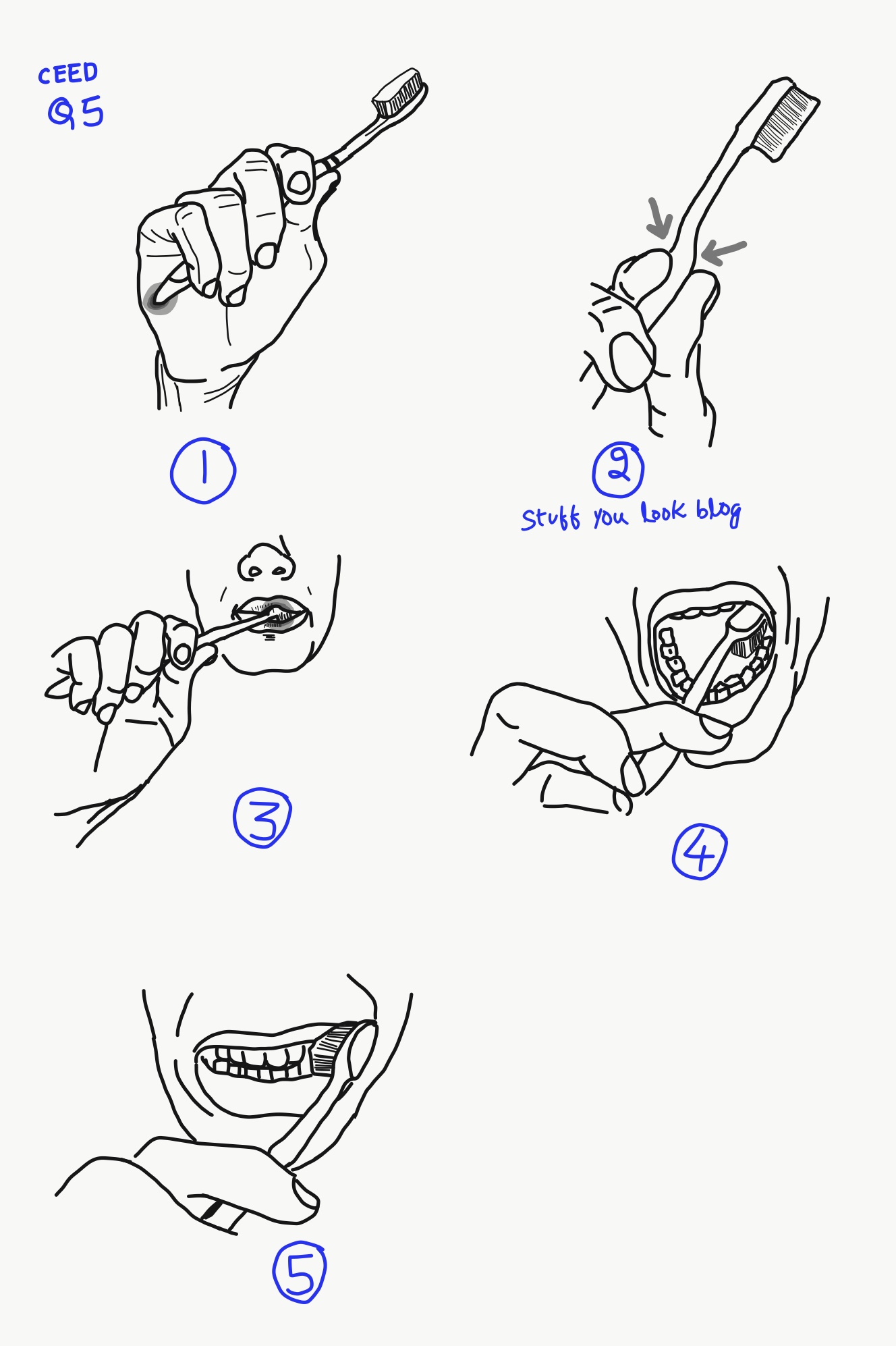

 
Problem description 
  1. Sharp pain at the palm surface where the toothbrush tail end is being pressed hard
  2. Uncomfortable and slip of grip at the mid-level while brushing
  3. Pain and rubbing of the brush back on the gums of the tooth during the front and back action
  4. Difficulty to reach the backmost teeth, causing discomfort of opening the mouth wide
  5. Difficulty in stretching the mouth wide when the brush is used to clean the front sides
Oops....I think I forgot to draw the 6th problem :D I hope that's ok. 

Points to remember:
  1. Don't spend time drawing a complete person or complete hand. The solutions should highlight the key highlights - the problems because of using the toothpaste. Draw only those parts that are required to express the problems. You can see how I have drawn partial hands and facial features. I think this should work.
  2. You don't want to draw the backgrounds and all. Not at all needed. 
  3. The problem description is supposed to come beneath the respective image. I've shown them separately for my convenience. 
  4. Don't show the solution :) or propose/suggest solutions in the description.

Sketching Level required/sufficient for CEED and UCEED exams


Hope this is useful.


31 March 2020

Part B UCEED 2020 sketching solution


In this post, I will share my rough sketch made for UCCED 2020 Part B subjective (mandatory sketching) question to give you an idea of how to solve such questions. 

The question as appeared in the paper 

I hope the below image of the question is clearly visible. If not, you can refer to the question paper available in the UCEED official website or in the 2020 part A solution page.


My rough solution done digitally (Adobe Draw app in iPad mini)


Sketch 1

Same solution with a little details 

Sketch 2


Few tips and points to remember


Referring to the above two sketches drawn by me, here are a few suggested tips and mandatory points to keep in mind
  1. First thing first, always.....always......always read the question properly and understand the requirement. I repeat to stress the importance.......READ the question and UNDERSTAND the requirements properly. If not understood in the first go, read several times. Because it's very very important to meet the requirements - as stated in the question. Also keep in mind the 'evaluation criteria' listed in the question. 
  2. Understand the 'Evaluation criteria' and try to sketch or design accordingly. Every centimeter of your sketch/design must try to meet the criteria listed by them. This is very important. For this specific question, the six criteria given are observation, imagination, selection and composition of objects, quality of line, presentation, and attention to detail. (Note that the solution that I've given as sketches might not be meeting all the criteria owing to my time constraint. But while you are attempting, you should mind these criteria. 
  3. Also, follow the instructions given as 'note' in the question
  4. In the sketch that I've drawn, I tried to show all the objects/items mentioned in the question and as required by them. I've not drawn Prof. Shastri as mentioned by them. Also, I've read the question carefully to understand the situation by noting the conversation between her and her husband. 
  5. Because of time constraints, I've shown only a few books and my sketch has space above the work desk. You can try showing more books since it was mentioned in the question that she has the habit of being untidy! 
  6. To improve your imagination and draw in proper perspective while at exam hall, what I would suggest to you is to place papers, pad, and mobile/desktop (whatever available at that time) on top of the desk and take advantage of the current situation at hand (a kind of copy sketch). This will particularly help with giving proper perspective to your sketch. In most cases, this works. When I was giving CEED exam back in 2013, there was a question about identifying the correct aadhar logo among the given four options. What I did was take out my aadhar in my wallet and check the options to answer it :P  
  7. Again, proportion, shape and size of objects w.r.t. each other and line quality are very important for any sketch of this kind. 
(Ignore the background empty space in the sketch and the title 'UCEED 2020' I had to keep the image in portrait to make it appear large in this post. I would suggest NOT to show unnecessary empty spaces, something like shown in the below image.)


I made the sketch in the following manner: 
  • First: understand the question and the requirement
  • Second: Visually imagine the scenario and think on what to include and where to position - like what items/objects are to be shown, where to position them w.r.t. the image,  in what proportion and angle etc. 
  • Third: Started making an outline of the view that I had in my imagination, sketching all the items in their assumed positions. I took care of perspective, line thickness, quality, size and shape(proportion w.r.t each object as per the perspective view). 
  • Fourth: Keeping in mind the given time of 30 mins, after I finished the outline of the sketch and based on the leftover time, I did the remaining sketch - like showing the keyboard, adding names or lines above the paper and books, drawing pakodas on the plate, showing steam over tea glass etc. as shown in the first sketch image above.
  • Fifth: Based on the leftover time  I tried giving little more details, like the texture of the desk, shadows of the book etc. (which is also the requirement of the question). Although I could only do a tiny part of it, I assume that you will give a good amount of details based on the time during your attempt. 
As already mentioned above, giving an outline to your sketch is very important than trying to giving a good amount of details but completing only say 50% of the sketch. As per my experience with CEED, what I understood is that the reviewers expect mostly an outline and a complete structure of the answer. So, be wise enough to start and complete the outline first before you move to give details. 

Now, to add further

Possible mistakes in the above sketch that I made 
  1. I missed showing the laptop completely. Part of it got hidden. This may not be a mistake but still given that Prof. was working on her thesis, probably I should've shown the complete laptop or desktop. 
  2. Some objects seem to be NOT in a proper perspective. I could've done better than what I drew. 
  3. The glasses are looking a little smaller in size as compared to other objects (especially the nearby plate). I should've drawn them a little bigger in size. 
  4. The books in the background are also smaller in size. I should've drawn them a little bigger in size - maybe 3/4th the size of the nearby bunch of exam papers. 
  5. Based on the perspective view of the laptop, the written paper beneath the laptop, mobile, the paratha plate and the books in the back, the bunch of exam papers should be given a little more perspective, maybe by showing more breadth.   
  6. The empty pakoda plate at the back could have been drawn better.   

The above are some mistakes that I could list out to help you with your practice and to give you a hint on how the sketch should be drawn better. You mihjt have spotted more mistakes, but ignore them for now (or take it as your learning to avoid such mistake in your own attempt) as like I mentioned, I had to make this sketch very roughly owing to my other commitments. 

I hope the above sketch solution gave you an idea to answer such questions. To remind you, I've already listed a set of Sample UCEED subjective practice questions last year (I will also update more questions based on this year's question). You may take them as a daily or weekly practice to improve with time by keeping the points, requirements and evaluation criteria in mind. I would suggest you practice mostly with pencils only! 

Sketching Level required/sufficient for CEED and UCEED exams


24 August 2019

Study materials for UCEED main topics

You are here UCEED >> Resource and books for UCEED
-----------------------------------------------------------------------------------------

Mathematical Geometry


Image-based reasoning is very important for UCEED. This requires good imagination and visualization skills. To get this skill, as a first step, you are advised to learn on how to visualize a given solid from all directions. This will help you build your aptitude skill. 

Here are set of my video tutorials that will help with non-verbal, design aptitude and geometry kind of questions

What to start? and How to solve design aptitude, non-verbal, and Ability questions with examples


PART 16


Maths Basics for non-math background design aspirants


How to count no. of surfaces in given solids


Here is my latest post - Improve imagination, work with 3D solids and unfolding of solid shapes


Some good video tutorials from youtube that help you with Solid transformations


source : Maths Online


source : Study pug


Other downloadable materials
Basic Geometry study (for reference) -
More - Sectioning of solids from NPTEL
    A very Good guide about - Using Perspective and Vanishing Points

    Observation and Visualisation skills


    1. Puzzles to improve observation

    Tangram Puzzles - 
    Downloadable PDF's
    PDF book on Non-verbal and Pictorial puzzles to improve observation

    Practice questions for Non-verbal (abstract test) questions

    2. Animation movement

    This topic covers the notion of frame making as used in animation. This basically involves the consecutive steps/positions of the image.

    Check the detail in downloadable (Pdf) form Tips for analyzing the pattern and graphic movements >>

    3. Working with Geometric Objects

    Some solved geomtry related questions (Pdf) with explanation -  working with geometry objects >>

    Learn a way of Solving number of faces on complex objects >>

    4. Hidden words and images

    Check the details in downloadable (Pdf) from here>>

    5. Tessellations

    Generally called as unfolded views, Tessellation is all about unwrapping a solid on a flat surface and drawing the unfolded view on a paper. I also gave easy way of solving tetrahedron tessellation problem in one of my pages. check below links

    My solution for tetrahedron tessellation problem - Tetrahedron Tessellation problem solving here>>

    Geometry representations by Malati - here>>

    Leisure time works

    • A detailed instructions on how to draw a tessellation by David B Sullivan -  here
    • Best tessellations work by Escher from teacherweb - here

    6. Illusions

    Improve Observation skills with Illusions -  here >>
    Second list of illusions - here >>

    7. Evolution of objects (less important)

    Evolution generally means product cycle from past to present. So, you are generally required to observe and identify the everyday use items (say TV) from old to new generation.
    check the details in downloadable (Pdf) from Some examples of evolution here >>

    General Design Awareness study topics


    I have covered a lot of topics related to CEED Part - A exam in my earlier posts for CEED students.  The topics are basically related to several design field awareness, their past, present and future. Fortunately, most of those topics can be directly helpful for UCEED aspirants also. Thankfully; that reduced my burden :)

    I therefore have included those selected topics and skipped some topics that might not be useful. Hope this will be helpful for your preparation. 
    Free time reference study

    Extra 1 - Mirroring
    • Uses of convex and concave mirror - here
    • Uses of convex mirrors - here
    • Uses of concave mirrors - here

    Answer/solutions to Previous CEED papers


    Solving previous years CEED Part - A questions would  help you with UCEED preparation as both the syllabus are mostly same. Spare some time to solve CEED questions too !


    ---------------------------------------------------------------------------------

    Self-Evaluation test

    Before going through further materials as part of UCEED preparation. Let's see this. Assuming that you have over-viewed the above resources (topics related to geometry and pictorial questions), I would like you to check your understanding of the concept by solving one simple question.

    Sample Practice question for self evaluation 

    --------------------------------------------------------------------------------

    --------------------------------------------------------------------------------

    Sample numerical and aptitude questions for UCEED

    English comprehension


    Comprehension material 1

    Very good exercise with answer key


    leisure time study - TOEFL material

    Indian cultural GA

    I strongly believe that - it's not that important to study topics like Indian Architecture, buildings, Indian past and present culture; but because I received requirement from a blog friend (through FB) to share these topics, I therefore include those topics here (that I have prepared for CEED).  I once again remind you that these topics are of least importance to your preparation !

    Indian state paintings and painters

    Indian musical instruments

    Something about India and time

    Cultural and complete Architectural collection of India  (Not Imp)

    --------------------------------------------------------------------------------

    Materials and manufacturing related


    I had detailed and categorized materials as well as manufacturing process with examples of day-to-day products. Don't spend much time on this topic ! Just give a brief overview.

    1. Every day materials - here >>
    2. Plastic materials and manufacturing process - A very good guide for household plastic materials and their manufacturing process. You may not go through manufacturing process, just note for what material, what particular manufacturing process is employed - here >>
    3. Tips for selecting plastic materials - here >>
    4. Top Indian stone and rock carvings - here >>
    A very good website for practising unfolded views of solids - Practice unfolded views of solids >>


    Like Stuff You Look blog on Facebook page to get connected with latest posts.


    20 August 2019

    Design Aptitude and reasoning study materials for UCEED


    A book of very good Mechanical ability questions PDF

    Here is a very good online website, where several free PDF files for practicing verbal, non verbal and psychometric tests are available in each page  that you can download and use for your practice - Free PDF's from assessmentday.com


    What to start? and How to solve design aptitude, non-verbal, and Ability questions with examples

    PART 1


    PART 16


    Maths Basics for non-math background design aspirants


    How to count no. of surfaces in given solids


    Odd-man out series exercises


    Leisure time exercises


    Direction sense test


    Leisure time practice


    Spatial and Visual Ability test samples


    Leisure practice


    Most of the sample test papers (PDF files) that I've included here (below) has been taken from Job Test Prep website. Big thanks to the web owner for including free PDF files!

    Inference from Paragraph and pictures


    Paragraph summary


    Para summary material - 1

    Para summary material - 2

    Leisure time study - material 3

    Deductive and Verbal Reasoning


    Inductive Reasoning and Conclusion drawing


    Signs, symbols and their interpretations


    A very lengthy but useful pdf file about signs in design context. Just have a quick glance for now. Later, if you are interest you may go deeply into this book - Signs and symbols with design

    Data Interpretation


    Abstract Tests

    --------------------------------------------------------------------------------


    Sample Numerical and Aptitude questions for UCEED


    Word/Pictogram puzzles (Rebus puzzles)


    Leisure time study - material 1

    Other IQ tests and exercises


    Analogy online exercise

    A very good guide for Mental ability and picture type questions -

    Mental Ability Test samples

    Logical arrangement of words sample practice


    30 May 2018

    NATA Exam - General Aptitude Free Study materials


    1. Mathematics and Geometric Aptitude


    The syllabus of NATA exam includes mathematics as well as Aptitude. Fortunately, you must note that mathematics syllabus is actually your school/college textbooks. So, I'm not including mathematics topics here while I covered the General Aptitude part at length. I will try to cover Part B (drawing part) in future posts. But if you couldn't find materials or textbooks for maths, let me know in the comment, I will search and add a textbook.

    What to start, how to learn the basics of design aptitude? 
    How to solve design aptitude, non-verbal, and Ability questions with examples


    PART 16


    Maths Basics for non-math background design aspirants


    How to count no. of surfaces in given solids


    Graphics - Front, top, side views, Isometric projections etc

    A very quick and good intro to Engineering Drawing

    Check till Page 28 - Engineering Graphics basics

    For further exercise and Practice


    Some very good video tutorials that helps you with Solid transformations


    source : Maths Online


    source : Godcast


    Orthographic projection examples

    Isometric view tutorial

    Other downloadable materials
    Basic Geometry study (Just for reference) -

    2. Nonverbal, Reasoning and Abstract Tests

    Odd man out series exercises
    Some more  odd man out series exercises

    3. Architectural related General Aptitude


    Roofing, Flooring, Tiling, Building Materials

    Floor tiles types PDF

    Floor types and treatments - 

    With pictures - types of flooring and their advantages

    Types of flooring and material uses 

    Flooring types used in India 

    Flooring materials

    Roofing types and materials

    7 best roofing materials 

    Wikipedia list of roofing material 

    Building materials for different climate conditions - 

    Properties of Building materials 

    Types of construction bonds 

    Online - Choosing different building materials for different climate 


    Famous Buildings, Architectural styles, constructions etc.

    PDF - NCERT collection of state wise architecture in India 

    PDF - A detailed list of temples, architectural styles with images 

    List of famous temples in India 

    Wikipedia detailed list of Hindu temples (overview during free time) -

    Era wise Indian architecture (briefly go)

    PDF of 100 famous landmarks around the world with images 

    Most iconic buildings around the world 

    100 most famous landmarks around the world

    Another list of famous buildiings

    The seven wonders of ancient, medieval, contemporary and modern worlds 

    Wonders of the world

    Architectural styles timeline (PDF) 

    Classical order in Architecture 

    20 famous historical sites in India

    Free time study 

    History of Architecture

    Glossery of Architectural terms

    Go in free time - 100 famous works of creative sculpture and statues around the world - 


    Terms and Texture

    Construction Materials - Quickly overview this book. Only study the part listed here - Timeline, Cultural and Material Context, Application, Grand Master

    Texture in wikipedia 

    Good guide on Texture in Architecture 

    Slideshare presentation on Texture 

    Color and pattern in Texture with basic terminology 

    Important terms - Architecture Elements and Principles


    Free time study and for future reference - Detailed Notes on Architecture


    For a list of Famous Architects - check the end of this page to get the list


    famous artists/painters with their pics 

    Indian cultural GA

    General Topics

    Learn about - Indian epigraphy history

    Learn about - Famous inscription in India


    Learn more about - Pica in wiki page

    4. English and Verbal Reasoning


    Sentetnce Correction and Completions

    Vocabulary Study Materials 

    A good PDF on Vocabulary (Synonyms, Antonyms, Analogies, Reading comprehension, sentence completion, right word etc.) 

    India GK online Practice

    5. Sketching/Drawing

    The following links might help you teach/learn on how to draw from memory/imagination

    Here is a blog with few tips on how to draw from memory 


    Leisure time study

    Superb book for learning sketching techniques and different facets of design (including perspective, shadowing, shading, texture, architectural facts etc) - Design drawing by Francis D.K.Ching

    A (very famous) complete pdf book "Basic Rendering" from Robert W.Gill, which covers most of the rendering topics including perspective projections (For those wishing to learn sketching/rendering)

    (More drawing related materials would be added soon)

    Disclaimer: The materials shared here are a collection of PDFs and online resources collected from the internet to ease your study process. The topics chosen are purely based on the analysis of the sample previous papers and may not include 100% topics.