My Analysis: After solving 2020's paper I felt the paper was quite easy as compared to previous years' papers. The level of the difficulty of the questions that I used to see in the past years was not seen in this paper. Good news!
Detailed explanation to some of the design aptitude questions of UCEED 2020 is available in the below set of videos
Solutions
1) 1020
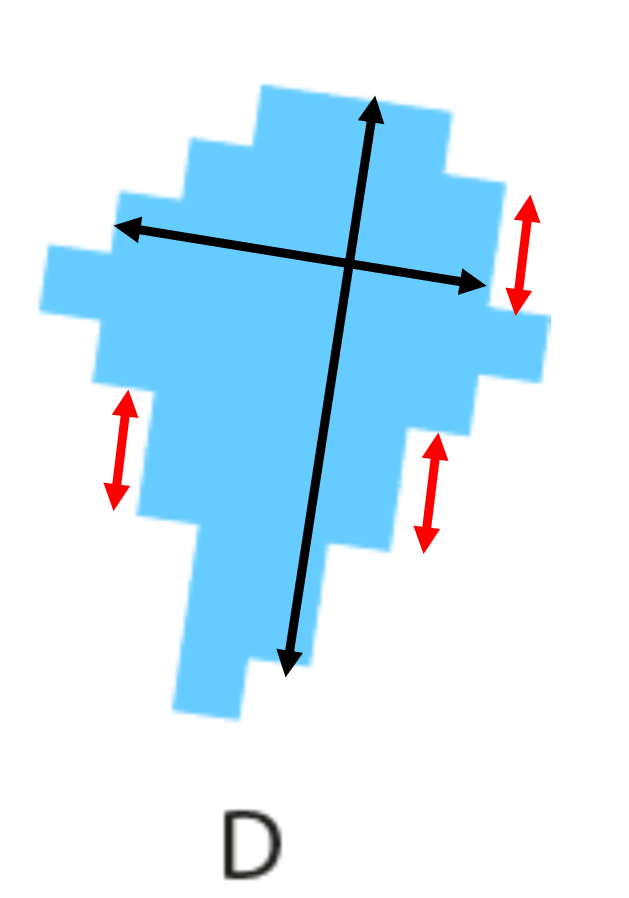
Let me give alphabets to each rod as shown in the image below.
Note that, the thread pitch of tools A, C, D and E are on one side are different as highlighted in red. They have 3 threads while the other threads of the tools have 4 threads. So, we need to be careful while fixing them. One possible order can be
-D-B-E-C-F-
which adds up to:
200+220+200+200+200 = 1020
Note that we can't use A here.
2) 33
For easy understanding, I've roughly drawn the lines in the below image.
No. of tiles in row A = 5
No. of tiles in row F = 4
No. of tiles in other rows = 6*4 = 24
Total = 33
3) 27
In the given die shown to the left, the opposite pairs of numbers are (1,5), (2,6) and (3,4)
In the first bottom row of the set of die's shown to the right in the question, 1 and 2 (dots) are visible. So, their corresponding opposite faces shall be 5 and 6 as per the pairs rule that I've mentioed above. The leftover pair is (3,4)
For the die on the second row (second from the bottom), numbers/dots 3 and 6 are visible. So, their opposite faces shall be 4 and 2. The leftover pair is (1,5)
For the third from bottom die, the visible dots are 4 and 5. Their corresponding pairs are 3 and 1. So, the leftover pair shall be (2,6)
In the top most row, 5 is visible at the top. So, its corresponding pair is 1 (1,5).
Therefore, numbers pairs parallel to the ground is are (3,4), (1,5), (2,6), (1,5).
Their sum is 3+4+1+5+2+6+1+5 = 27
4) 21
In the first image below, I've marked the unique squares. As can be seen, no. of squares = 5+4 =9
In the next set of images, I've drawn the possible square arrangements such that there are four dots at the corners of the squares.
Total = 9+4+4+2+2 =21
5) 140
To find the solution, let us consider only one pattern as shown in the below image. I've partitioned the pattern into regions, namely A,B,C,D. Here C and D are the same shapes.
A is easy to obtain, the area is half the square area = 1/2x(7x7) = 24.5
C can be obtained in the following way.
Area of C = Area of half square (say A) - area of B
(Note that area of B and C taken together is half the area of the square)
Fortunately, area of B = area of sector of length 7 and angle 45 degrees = 1/2*square(7)*theta
Here theta should be converetd to radians, PI readians = 180 degrees
so, 45 deg = PI*45/180 = (22*45)/(7*180)
so, area of B = 1/2*square(7)*(22*45)/(7*180)
B = 19.25
Area of C is thus, = 24.5 - 19.25 = 5.25
Area od D will also be 5.25
So, the area of one pattern in black = 24.5+5.25+5.25 = 35
For sour such pattrns, area = 35*4 = 140
6) 16
This can be solved by using the concept of permutations used in mathematics (if you cannot understand below, you can visually assume of different patterns for the answer)
A single tile (of four sides) can be arranged in 4 ways (each side as the base everytime). Likewise, the second tile can be arranged in 4 ways. So, the total no. of ways of arranging two tiles, 4 ways each is 4*4 = 16
(To clear, for each tile position of say tile A, tile B can be arranged in 4 ways.)
7) 9
As highlighted in the below image, in the first row, three cubes get cut. This is because the cut plane passes through the edge/corner vertex of the cubes. For the other two rows, 3 cubes will get cut in each row.
8) 10
As shown in the first image below, I can draw two lines randomly and count 4 triangles.
In the second image, I've highlighted three possible triangles.
In the third image, I've drawn blue and green colored triangles.
In the fourth image, I've highlighted the other possible triangle.
Total = 4+3+2+1
9) 8
I've numbered the unique motifs in the below image
10) 19 17
A correct explanation to this question was shared by Priyanka Johri in her comment below. (check the fourth comment at the end of this page)
The below solution, previously shared by me, is wrong. Hence, I'm striking out this.
Since the daughter is the fastest person to walk, she will be the person helping the remaining people.
In the first trip, she accompanies her grandfather to their home and returns back with the umbrella to the bus stop. The time taken would be
T1 = 10+1 = 11
Time taken to accompany the father and reach back to the bus stand T2 = 5+1 = 6
And time taken for her and her brother (son) to reach home = 2
Total time = 11+6+2 = 19
11) 3
'Cards that have a vowel on one side always have an even no. on the other side'.
To make this statement true,
rule A: we are not worried about non-vowels.
rule B: Also, this statement doesn't say that all even numbers must have vowels on their backside. But, says that the cards with vowels must have an even no.
We are not interested in M and R cards as per rule A.
We are not interested in card with no. 8 also (card with even no. can be wither vowel or non-vowel also), as per rule B.
So, we are interested in checking 3, 7 and E cards
12) 16
The figure below shows the rough construction of the pattern. Note that surface 2 is continuous as shown in the second fig and hence it shall be considered as a single surface (similarly, surface 3 is continuous and accounts to one surface).
13) 365
Let's find the answer in terms of 'no. of days' first before converting to hours.
First check if 2018 is a leap year or not.
A year is leap year if it is exactly divisible by 400.
2018/400 = 5.045
Not a pefect division (the above has reminder)
So, it's not a leap year and hence consider 365 days.
Given in question,
No. of days spent in working = 365/2
No. of days spent in sleeping = 365/3
No. of days spent in cooking = 365/8
No. of days spent in exercising = 365 - (365/2+365/3+365/8)
(or, the reminder of 1/2 + 1/3 + 1/8 is 1-(1/2+1/3+1/8) = 1/24)
= 365/24 days
No. of hours spent on exercising is therefore 24*365/24 = 365 hours
14) 8
Below image with colored patterns will give you an idea. This is just one possibility. Try with other possibilities also and you will still get 8 empty spaces.
15) 2
As shown in the first image below, the red plane indicates the first cutting plane. This plane will pass through the mid of the wooden plank and the cutting on the wooden plank is highlighted by orange cutting lines. We get two equal halves of the plank.
Now, take the top half and place it on the same horizontal surface on which the first half was lying, so that they are close by or side by side, one possible placement is shown in the second image below. Now, cut both the halves simultaneously by a bigger cutting plane, shown in blue in the picture.
16) 7
The below image highlights the differences.
17) 44
I've given numbers in the below image. Note how I moved from top to bottom and left-right, right left row wise. This will help in removing confusion while manual counting.
18) 2
Shown in the below image.
19) A, C
The first check would be to observe the position of the center + and cross in the given question and the position or orientation of the shapes inside them with respect to the + or cross as highlighted in the below image. Given + in the center in the first circle in red, the circle and triangle shapes lie opposite to each other. Identify a similar pattern for the second circle. Now, in option A and C satisfies the first circle pattern in red. Now, try overlapping the two circles as per the option A and C and see if they can be obtained.
20) B
Only statement B is true while the rest are violating.
21) A, C, D
Option B is missing a transparent line as highlighted in the below image. All other options are possible.
22) C, D
I've drawn the situation in the below image.
P's travel denoted by green line and Q's travel by orange line. R's travel by Purple line.
P met Q at the green dot as shown while Q was supposed to travel along the dotted line. After they met at the dot, they walk and reach R. From R's home, the three travel to T's home.
Assuming that all the friends walk at same pace (speed), let's check the option and see which are correct
A. Actually the distance travelled by P and Q to reach the green dot (O) is the same, i.e PO = QO. So, the distance travelled by P and Q are actually same.
B. The above discussion applies here. Note that T is quite oposite to T, just like R is quite opposite to P. So, they meet at the same distance.
C. Since PO = QO,
QO+OR = PO+OR, which is equal to RT. R walked a distance of RT while Q walked a distance of QO+OR+RT = 2RT
D. As is clear from the drawing, P has to travel just by distance TP, which is the least.
23) A, C
By observing the shadows it is clear that the light source is located somewhere at the top right to the three objects. So, the length of the shadows casted by the three objects varies and need not be of same length. Shadows shown in B and D are all of same length, which doesn't fit the hypothesis.
24) B,C, D
Except A, all other statements are true.
25) B, D
Answer is straight forward and I don't think explaantion is required for this. D is just the flipped version of B (assuming that you are facing south instead of north). But be cautious of the shadow projection.
26) B, D
When we sharpen a pencil using a sharpner, the sharp edges would be the first to be cut more. A is opposite to this while in C some edges have lesser cuts. B and D are actually the same, just that D is a slight rotated version of B.
27) C, D
I've shown cross section of the cut part (red hatching). After the cut and let's say I try to ove the top cut ribbon to the left as shown by arrow, the part half cut ribbon peice will lock itself at X. The same is tru if you try to move in the opposite direction or in any direction. Regardless, the two halves of the ribbons will have one color (green) on one face and another color (pink?) on the other face.
28) A, B, C
Given statements are:
Su > M
M < F
W < Sa
Tu > Sa
W, Th > F
29) D
Consider the situation shown in the below figure for option C. The arrow shows the length of the side, equal to L. In option D, if we try to fold along the dotted lines, one of the sides has greater breadth/height, shown by green arrow and its dimension will be more than L. But this should actually be L. So, D cannot be actually folded into the required shape.
30) B, D
As shown in the below image, for option B, the white hand is missing, as highlighted by red circle. For option D, as shown by the blue horizontal line, the level of the inseam (two legs joints) and the hand is not as per that shown in the question.
31) A, B, C
Below pictures shows the situation in arrows. As can be seen - A, B and C cups cannot be stacked while D is possible.
32) B, C, D
As shown in the below image, one or two of the patterns in B, C, D are not following the circle pattern.
33) A, B, C
In the below image of the question, I've marked 'a' and 'b' as two landmarks. Let us see where the options nodes 'a' and 'b' matches with the question.
Option A can be overlayed without any alteration on top of 1. The landmarks 'a' and 'b' are denoted to match it.
Option B can be overlayed on top of 1, after flipping B along horizontal.
Option C can be overlayed on top of 1, after flipping C along vertical.
Option D has one extra and one missing line as highlighted in red in the below image.
34) A, B, D
Below image shows the situation as per the condition given in the question. Based on the hexagon, the correct options are easy to identify.
35) B, D
By observation
36) B, D
Figure shows one possible orientation for the yellow dice and blue dice.
Sides 1, 2, 3, and 4 are the corner faces, one of then can go in the X space.
Possible faces with numbers 1,2,3 and 4 and their corresponding dots 2,1,3, and 6
dots 4 and 5 are not possible.
37) A
Whenever you come across this kind of patterning with colors or objects/shapes, the best thing to do is to count the no. of similar colors or shapes and how they are varying in every pattern. In this question all the patterns have same no. of colored dots and so this method doesn't work. The second important thing to observe is the movement of particular colored dots (a few set). In general, we don't have to check the entire dots/colors in the pattern (for this kind of question). Identifying the key colors/dots/shapes and trying to figure out the pattern out of their movement is what we need to do to solve these kind of probelms very quickly.

Observe the three violet color dots in every pattern from left to right. As you can see the three dots (and hence the other violet dots) are moving counter clockwise in every pattern step by some degrees (may be 45 degreees, the angle is not much imp here). Following the dots pattern, the position of the three dots for the pattern at the question mark should be as shown in option A or option D.
As a further screening, observe the movement of the three green dots (highlighted in the second image) in every pattern. The three green dots (and hence all other green dots) are moving in clockwise direction by a small angle (say 15-20 degrees). Following this trend, the green dots should be positioned as shown in option A, while B has wrong orientation of the dots.
38) C
For your understanding, I've drawn the cuts along the two slant paper planes. The planes cuts the paper roll at the respective points a', b', c', d' and e' (marked for both the slant planes). By observation you can see that the cuts gap between the two planes at say e (e'-e') denoted by h1 (also shown in the second image, see the image from right to left) is the largest possible length. At c (c'-c') they exhibit the least distance between the two cut planes, denoted as h2. At the second turn bottom,f, (f'-f') the cut distance will be slighly lower than e'-e' but definitely higher than c'-c'. The gap distance b'-b' is slightly higher than c'-c' but lowert han e', f', a'. I hope this is clear.
39) D
Whenever I come across font type questions, I try to find a unique pattern out of all the letters/alphabets. For this question, I observed that the extension ends of all the alphabets are either horizontal or vertical with sharp corners. The first image below shows all horizontal ends and the second image shows all vertical ends. As I observe the options, only D has this kind of feature, while the letters in the rest options are not matching. (FYI - If say this check had failed, I would've gone for the next level of pattern check - like for ex. the curves/bends, lengths of extensions, thickness changes etc., you can try this for similar questions).
40) B
As shown in the below image with A and B options side by side, the reflection of the distance shown by arrow at the point where the kid was seated must not be the same as in the real situation - given the angle from which she was observed by the viewer (us). B and D suits the reflection of her sitting position. Now, the eyes of the kid in D option makes us beleive that she was looking straight, but tshe should be looking slightly above the paper boat, shown by blue arrow.
41) A
An easy question..........if you observe the direction of the ant travel (and hence its view), it's almost parallel and inline to the left frame 'a' as shown in the image. So, the frame will appear the least to its view.
As shown in the second image, the position of the point b should be higher and along the vanishing line (red dashed) to that of the vanishing line in blue dash. This is because, in persepctive, the nearest object to the eye appear closer to the bottom of the image (and bigger in size) while the farthest object to the eye appear smaller in size and also away from the bottom of the image captured. In option D, this is reversed and hence wrong.
42)
I'm too lazy to sole this kind of question :P
Refer to verbal reasoning resource of CEED and UCEED page for more help on this typw of questions.
43) A
The travel from T1 and T2 is faster and the travel from T2 to T3 is slower with respect to the constant speed of the rotating cylinder. So, the pencil line from T1 and T2 will have steeper angle than the pencil line drawm from T2 and T3. In options, the motoiin is shown from right to left. Also, the line drawn will be pretty straight from start to end regardless of the speed of the cylinder or the speed of the pencil vertical movement.
Additional points for your understanding:
Another observation to note is the width (horizontal measure) of the steep line drawn in the portion T1 and T2 will be same as the width (horizontal line) of the pencil drawn when the pencil is not moving. That's because, in ten seconds, the cylinder would move to only a particular amount.
The third point to note is that the width (horizontal) line from T2 and T3 will be 40/60 times the width of the whole pencil mark (60 is the total time and 40 is the time for T2 and T3).
44) C
As you see, when the light rays falls on the opaque object, they will tend to project along the corners as highlighted in the image. However, interestingly, since the object is circular, their projections onto a plane (the ground in this case) that is parallel to the object will retain it's shape. The only difference is the object shadow will appear enlarged.
45) B
Highlighted the jumps of the knight in the order numbered. 6th jump will be at X.
46) D
As shown in the image below, in D, piece number has to be flipped.
47) C
This is a good example to shoe the difference between this and 44th question. In 44th ques, the object plane is parallel to the projected plane and hence the shape was retained. In this question, the objecte plane (cut-out) is not parallel to the projected plane (the ground). So, the top edges of the shapes in the cutout (for ex., the top horizontal edge of the triangle) will project farthest than the bottom edge (vertex) of the triangle. Likewise, for the star and the circle objects, their projections will be stretched. Again, since the height of the circle from the ground is lesser than the height of the tiangular cut, with respect to the light source at the stand post, the elongation of the projection of the circular object will be lower than that of the triangular projection, with the star projection being in the mid of the two.
48) B
If you observe the dots in each pattern, you can notice the following pattern
1. An individual dot in the area within each shape while no other shape overlapping. For ex., in A, you can notice one dot inside the rectangle, which is not falling within any other shape. Similarly, observe dots within other shapes too.
2. A dot within the area formed by the intersection of all the shapes.
Only in B, the dot, that should be enclosed only within the circle has been shared by the circle and the rectangle as highlighted in the below image, which is wrong.
49) C
D is more unrealistic (troublesome) legs postion. Two legs front while he leaning back, that too with the heavy weight, will make him fall behind. A is more like the person was not able to move and was about to collapse or fall down. Discussion for B is similar to that of D.
50) B
Assuming that the color of the solid walls maintain uniformity (inside and outside), the following numbering process will help you identify the respective sides.
51) D
I think this is pretty straightforward. Just identify the continuation fo paint horizontally and the gaps in between.
52) C
(Note, below I tried to solve the complete table for your understanding of the solution. You can short this to find only the question mark at the earliest)
I see this similar to the game of Sudoku. What I do is give unique number for each color and try to solve this sudoku. I've shown in the below image, based on this you can see the colors in the question marks.
First number the given colors (shown in black), then give some work to your brain ;) in filling the remaining squares with numbers such that each row, each column and each compartment has all the 6 numbers.
Numbers in blue are the ones filling the squares. Note that the circled numbers are the numbers denoting the squares attempt or flow. I've started at the square circled number 1 (4th row, 5th column) and moved successively until I reached circled number 24. I'm including this too as I felt this would help some of you.
53) C
It is clear that the dragon's eye level is the same as the tallest building height and the helicopter is flying above it's eye level, to the left of it.
54) B
The pattern movement is how in the below image. Note the numberings and the movement of the red dot in successive patterns.
55) D
By observation.
56) A
Goven that the lightening is the only light source, it is clear that the area within bounded by the towers inside which the lightening is happening will be lit while the towers will cast a shadow on the outer side of the towers. With this understanding, options B and C are not correct. Now, since the lighening is happening from the clouds, the clouds shall be lit from outside. So, D is not correct.
57) D
Not so easy question. But, with careful observation, we can deduct the shape with the largest or least area. First, I will tend to check the width and length dimension of all the options. After that, I will check what approximate portion of the rectangle area formed by the two dimensions are occupied and unoccupied.
In the image shown, the dimensions shown by black arrows together with slightly larger portions (compared to the similar portions in the other options) of the red - made me believe that this option is occupying more space. If not convinced, you can always try to segment the area as small blocks of say 1 square unit and then check which option has the highest no. of smaller blocks.
58) D
What I did is take one option, say option P, and tried to visualize two such shapes assembled together. For your understanding, I've shown my imagination in the below image. This will give clear picture of which shape is associated with pattern. For further confirmation, you can try to visualize another option.
Probably if I rotate the image as shown in the second image, it will help you match the pattern shown in 3.
Quick tip: if you observe the choices given, for 4, in every choice, they have unique alphabet. So, I would choose to do the above exercise of imagining another similar pattern that would seem/obvious to for pattern 4.
59) B
By close observation. In the below images, I've marked the missing parts in the other options.
60) B
Figure shows the position of the points on the circles which will role and position as shown by red arrows.In option B, if you draw a vertical section line X-X', the position of the above points should be oriented at the same circular distance on eother side, as shown in the bottom image.
61) C
In the top image shown, blue arrows show the requirement of lowering the clothes line. The corresponding travel of the rope at different parts are shown by green arrows. Start at the knot with shown marked (circled) as 1, then move in the opposite direction of the rope travel as marked by numbered circles. Given the direction of the rope travel, it is now easy to identify the direction of rotation of the pulleys. This is seen in the second image. Refer both the images to mark the blue arrows.
62) A
I think this is obvious and easy.
63) A
Following the two criteria of rotations, it is easy to differentiate the options.
64) No answer
None of the options match. The projections will be as shown in the image.
65) C
In the below image, I've shown the parts that can form into a square.
66) B
As a start, consider only the outer lines in the first two patterns A and B of the first row. In the result (third pattern of the same row) the outer lines will consist of all the lines available in both the patterns A and B.
1,2,3 in A
1', 2' and 3' in B
The result will consist of 1, 1', 2, 3(2'), 3'
When checking the inner lines, consider only those lines that are available (at the same location) in both A and B patterns and ignore those lines which are not available or are available only in any one pattern.
a,b,c,d in both A and B
Now, in the last row, as shown in the second image, the outer lines 1,2,3,4 as well as 1',2',3',4',5' will be retained in the result - shown as green line
The inners 1,2 will only be retained as they are available in the same location in both A and B.
67) C
One way to interpret this is - the objects shown: movie/video, idea (plan), sea travel, person with gun, direction sense, fish to highlight sea probably represents a navy general or navy person. So, C might fit.
68) A
After the cut, unfold the paper in the reverse direction of the fold. The following image depicts the process.
I hope my explanations helped you understand the answering process. All the best!