Showing posts with label CEED. Show all posts

12 January 2021

CEED last few days preparation priority list

 List of topics to prepare and to skip (2021 update)


Part B

  1. Avoid spending hours for sketching of one particular question.
  2. Problem identification (given a product or scenario) and creativity are the the two area which you should continue till the last day. You don’t have to sketch, just list down the identified problems or quickly scribble the creativity part.
  3. Do quick scribbling of line sketching and do a few situation based exercises too, like at least two situations in just one half an hour!
  4. Don’t spend more than three hours per day for part B, if you have the whole day for your preparation.

Part A

  1. Skip current affairs and GK
  2. Skip Materials and Manufacturing process study
  3. If you have started your preparation recently - skip design awareness (like culture, designers, painters etc. - from here on let’s term this as GA)
  4. If you have been preparing for a while, esp. the image based and non verbal part and haven’t touched GA part then quickly revise the following GA topics
    • Painting, state wise painting, art and all.
    • Quickly go through colour theory
    • Famous designers,
    • Quickly about photography
    • Based on leftover time, plan to cover any other GA topics that you felt imp.
    • Revise and practice some samples of nonverbal and image involved aptitude questions, including ability questions
    • Practice at least one previous paper with a time limit. It’s fine to cross check the answers but never ever try to estimate the score or check if that score is sufficient or not! Remember, whether you prepare or not your positive attitude and confidence are very important and if you keep comparing scores you might loose your confidence....for no reason. So be smart!
  5. If you are not ready with non verbal too (just started), then do the following
    • Skip current affairs
    • Skip entire GA including about designers, materials etc. No need to touch any and it’s absolutely ok, especially if you feel you can pick up some score from the below preparation
    • Practice wholly (apart from the sketching) on
      • Abstract tests
      • Solids and their manipulation (folding, unfolding, different views, counting no. of surfaces etc.)
      • General, mechanical and spatial ability
      • Deductive reasoning
      • Odd man out series
      • Revise basic math formulas (check the formulas in this video and they are more than sufficient)
      • Skip signs, symbols etc,
      • Skip paragraph comprehension (just face them during exam)
      • Base on time availability you may plan to cover the utmost imp GA topics as listed above
  6. Again, Practice at least one previous paper with a time limit. It’s fine to cross check the answers but never ever try to estimate the score or check if that score is sufficient or not! Remember, whether you prepare or not your positive attitude and confidence are very important and if you keep comparing scores you might loose your confidence....for no reason. So be smart!

That’s it...


All the best, 
Your bro,
Bhanu. 

19 August 2020

NID Industrial Design - MDes Domain Specific Practice Questions

The following questions are meant to assist you with your NID preparation (MDes domain-specific subjective part), especially fro the domain-specific test 'Industrial Design' as per the new pattern from NID 2020. I've made the following question to make you realize how easy it is to come up with your own questions using the situations around you, including the use of the internet. 

I - Question Type 1 (Creative and alternative thinking ability)

Draw 5 different uses (other than their intended use) for the following objects listed below. Each idea carries 2 marks.

  1. Writing pad (plastic )
  2. Earrings
  3. Cloth clip
  4. Safety pin
  5. Pen cap
  6. Umbrella
  7. Phone cover (rubber made)
  8. Beverage (fruit juice) tetra pack
  9. Toothbrush
  10. Tounge cleaner
  11. Shoe cardboard box
  12. Geometry box
  13. Mop
  14. Mosquito bat
  15. A computer mouse with cable
  16. CDs
  17. Fork
  18. Hat
  19. Pen refill
  20. Pen stand
  21. Bulb
  22. Tennis ball 
  23. Face mask
  24. Used coke bottle
  25. Plastic water pipe (any length) of dia up to 1 inch
  26. Disposable spoon

II - Question Type 2 (Problem identification ability)

Marking - (Each problem carries 10 marks- each sketch and the associated writeup carries 2 marks. So, don't prefer giving details to the sketches. Convey the ideas in a simpler way.)

  1. Imagine a person standing and ironing his/her cloth using an electric iron box. Depict through sketches - 5 (five) problems faced by the person doing the task. Also write in a sentence (not more than 4 lines) the problems identified and depicted in the sketches. 
  2. Imagine a person peeling off the skin/surface-layer of carrots. Depict through sketches - 5 (five) problems faced by the person doing the task. Also write in a sentence (not more than 4 lines) the problems identified and depicted in the sketches. 
  3. A physically disabled person has a problem with the spine that the person cannot raise his/her head up. The person can lower his/her head to a little from the horizontal position. Depict through sketches 5 (five) problems faced by the person while drinking water from a one liter bottle. Also write in a sentence (not more than 4 lines) the problems identified and depicted in the sketches. 
  4. Imagine a person using a desktop mouse while working. Depict through sketches - 5 (five) problems faced by the person doing the task. Also write in a sentence (not more than 4 lines) the problems identified and depicted in the sketches.
  5. Imagine a person using a desktop mouse while working. Depict through sketches - 5 (five) problems faced by the person doing the task. Also write in a sentence (not more than 4 lines) the problems identified and depicted in the sketches.
  6. Imagine a person wearing mocassins/loafers (shoes - slip-on kind) with hands. Depict through sketches - 5 (five) problems faced by the person doing the task. Also write in a sentence (not more than 4 lines) the problems identified and depicted in the sketches.
  7. Imagine a person chopping vegetables in the kitchen. Depict through sketches - 5 (five) problems faced by the person doing the task. Also write in a sentence (not more than 4 lines) the problems identified and depicted in the sketches. 
  8. Imagine a person wearing mocassins/loafers (shoes - slip-on kind) with hands. Depict through sketches - 5 (five) problems faced by the person doing the task. Also write in a sentence (not more than 4 lines) the problems identified and depicted in the sketches.
  9. Imagine a person emptying their household domestic dustbin into a large public dustbin, both with closed lids. Depict through sketches - 5 (five) problems faced by the person doing the task. Also write in a sentence (not more than 4 lines) the problems identified and depicted in the sketches.
  10. Imagine a person wearing a face mask for prolonged hours, as part of Virus prevention, while working at office. Depict through sketches - 5 (five) problems faced by the person in wearing the mask. Also write in a sentence (not more than 4 lines) the problems identified and depicted in the sketches.
  11. Imagine a person using an electric trimmer to shave their beard. Depict through sketches - 5 (five) problems faced by the person doing the task. Also write in a sentence (not more than 4 lines) the problems identified and depicted in the sketches.
  12. Imagine a person using a gas stove lighter in kitchen. Depict through sketches - 5 (five) problems faced by the person doing the task. Also write in a sentence (not more than 4 lines) the problems identified and depicted in the sketches.

Check similar questions released for CEED practice here


III - Question Type 3 (Problem-solving ability)

Give 2/3 original solutions that would help you carry your locker keys with you while going to college/office without the possibility of you forgetting to secure the keys with you. Depict the solutions you have proposed communicating how they achieve their goal. 

(Marks - 16 marks, each solution carry 8 marks) 

  1. Give 2/3 original solutions that would help you switch off the electrical appliances, including light and fans, before you step out of your room, without the possibility of you forgetting to switch off. Depict the solutions you have proposed communicating how they achieve their goal. 
  2. Give 2/3 original solutions that would help you get far from book reading or working in front of desktop/laptop (a break from the continuous task) once in every hour without the possibility of you ignoring and continuing the task. Depict the solutions you have proposed communicating how they achieve their goal.
  3. Give 2/3 original solutions that would help you maintain a healthy sitting posture (for the back) whenever you sit for reading, working, or even driving, without the possibility of you leaning back in wrong posture as if relaxing. Depict the solutions you have proposed communicating how they achieve their goal.
  4. Give 2/3 original solutions that would help your children optimize/limit their presence in social networking sites like Instagram, Facebook etc. without the possibility of you being indulged into that constantly. Depict the solutions you have proposed communicating how they achieve their goal.
  5. Give 2/3 original solutions that would help your grandmother take prescribed medicines every day, without the possibility of she ignoring or forgetting to take. Depict the solutions you have proposed communicating how they achieve their goal.

(similar questions for practice)

  1. Give 2/3 original solutions that would help you drink at least one glass of water every hour without the possibility of you ignoring and continuing your long hours' work/study. Depict the solutions you have proposed communicating how they achieve their goal.
  2. Give 2/3 original solutions that would help your father take deep breaths (mindfulness) for at least one minute at regular intervals, every day, to relieve stress and maintain healthy heart function without he getting ignoring the mindfulness. Depict the solutions you have proposed communicating how they achieve their goal.


IV - Question Type 4 (Design thinking ability)

For the questions listed below

  • Make a realistic drawing of the product designed, showing the relevant details.
  • Indicate the product's main features with labels in the sketch you made.

Problem statements:

  1. It's rainy season and you need to carry the following items to your college/office: laptop, files, mobile phone, chargers, swimsuit, Tiffin box, juice and water bottles. Design a product to enable you to accommodate and carry all these items in it together exclusively to be used during rainy days.
  2. Design a multipurpose pocket survival knife to be used by Indian Army soldiers when on an expedition. Identify the different needs and purposes of tools that can be included in a single product.
  3. Design a mosquito hunter robot (a tiny drone) the purpose of which was to hunt down any flying mosquitos that can bite humans in the room. Ignore the technical aspects and assume appropriate sensors, including mosquito detection and tracker. Showcase the features and the form of the robot to deal with the mosquito catching. The robot should also store the captured and killed mosquitos and should be able to dispose of them out after a few hours of operation. 
  4. You are a nurse and you need a product to carry the following items: antibiotics, stethoscope, scissors, medical tape, cotton, some liquids like tincture, lotion, sanitizers, sterilized mask, gloves, cotton ball, thermometer, tongue depressor etc. Design a product to enable you to accommodate and carry all these items in it together. The product should be easy to carry, portable, lightweight, and should preferably protect the components inside from fall or environment.
  5. Design a product to carry the following products safely: wired headphones, charger and charging cables, bluetooth headphones and/or over-the-ear headsets etc. The product was meant to carry the cables and items, tangle-free, and also to keep all the usable items in one place. 
  6. Design a cleaning and carrying product meant to be used in a multiplex that can help the housekeeping staff with mobilizing and doing the following tasks: has separate collection units for trays, dry and wet wastes and to collect bottles (both plastic and glass), a portable vacuum cleaner without cables, a mopping unit, facility for towels/clothes etc. The mobile product should facilitate the housekeeping person to take it around comfortably. 
  7. You want to stock all your gadgets as well as small jewelry at one common place so that you can access them at ease the next morning. Design a product that can safely accommodate the following: mobile phone (a stand type), smartwatch, truly wireless earphones, jewels like finger rings, chain, bracelets/bangles etc. The product should be such that when you try to access them in the morning right after you wake up from bed - in a half-sleep state - none of the items should go damage.  


V - Question Type 5 (Imagination and drawing ability)

Do the following for each of the listed scenarios 

  • Visualize and draw the 3D views of the scenarios mentioned below. (each scenario carry 5 marks. Details may not be needed).
  • Also try to draw shadows for all the situations, assuming a light source to the right of your view. Objects in actual size. 
  • Imagine that the first object shrinks to half its size and the second object enlarges to twice its size. (each scenario carry 5 marks. Details may not be needed). 

 Problem statements:

  1. A bucket (first object) and a Jug (second object), both resting on flat ground next to each other 
  2. A Laptop and a coffee mug (with coffee) both on top of a flat table
  3. A two-liter coke bottle and mobile phone both on the same flat surface
  4. A basket full of vegetables and a bowl of soup


You may find similar questions for practice, which are already listed in - NID subjective practice questions


18 August 2019

Non-verbal (Image based questions) guide for design exams


A. Mathematical Geometry


CEED/UCEED questions (objective type) covers a significant amount of mathematical aptitude; especially geometry type questions. Keeping this in mind, I have gathered some useful materials related to basic geometry. The understanding of this subject improves your skills (observation, imagination and lateral thinking). 

What to start? 
How to solve design aptitude, non-verbal, and Ability questions with examples


PART 16


Maths Basics for non-math background design aspirants


How to count no. of surfaces in given solids


Some very good video tutorials that might help you with Solid transformations


source : Maths Online


source : Study pug

Other downloadable materials
Basic Geometry study (Just for reference) -
    A very good guide about - Using Perspective and Vanishing Points


    B. Observation and Visualization skills


    1. Puzzles to improve observation

    Tangram Puzzles - Downloadable PDF's
    2. Working with Geometric Objects


    I worked some examples and included a step-by-step process for solving some geometry type questions for your understanding.


    4. Tessellations

    Generally called as unfolded views, Tessellation is all about unwrapping a solid on a flat surface and drawing the unfolded view on a paper. 


    Geometry representations by Malati - here>>


    Leisure time works

    • Detailed instructions on how to draw a tessellation by David B Sullivan -  here
    • Best tessellations work by Escher from teacherweb - here


    C. Abstract Tests

    Let me tell you that questions from Abstract reasoning tests might not come in bulk in CEED exam. But, Abstract reasoning tests would helps you with pattern findings.
    Theses tests were taken from pscychometric-success.com
    1. Test 1 - here
    2. Test 2 - here
    3. Test 3 - here
    4. Test 4 - here


    D. Spatial and Visual Ability test samples


    Leisure practice


    E. Word/Pictogram puzzles (Rebus puzzles)

    Leisure time study - material 1


    23 January 2017

    UCEED exam general discussion - FAQ's Page 2


    My reply to the most asked questions


    Q1)

    "What is the cutoff for UCEED/CEED/NID? (or any other design exam) 

    UCEED or any other design exam for that matter does not maintain a fixed or standard cut off every year. Exam cut off varies every year based on the following factors

    • Number of students appearing
    • Exam difficulty level
    • Maximum marks scored by the first ranker (and subsequent top 100/any other numbered people)
    • Density or number of people having same marks or score
    • Average marks obtained 
    • Number of students having marks within a given range etc
    So, it's not that easy to tell - for a given marks, whether that is accepted or within a range. Just based on marks, we cannot predict AIR or cutoff. Sometimes, for lower marks also, there is a chance of getting good AIR (if the exam was difficult and the average of all the people's attempt were low) and vice versa. So, just don't get confused but wait until the results or score list!


    Q2) 

    "I got xyz marks based on UCEED/CEED/NID results or from the key, will I get seat in abc institute ? (or any other design exam) 

    Again, institute cutoff's varies every year based on the above discussions. If there is a post UCEED process just like CEED, NID-DAT and other design exams, then it's not necessary that institutes take only the toppers! they will also give weight-age to any/some or all of the following - merit, performance in interview, studio tests, portfolio etc and more. So again, discussion for Q1 is applicable and must be justifying here.

    Previous students discussions and FAQ page


    Please don't repeat asking this question again and again. Thanks.


    28 December 2016

    CEED one month practice topics - quick list

    (Updated with new strategy from 2021)

    A very quick list of topics useful for one month CEED preparation.  

    Before that I will answer the question that might be troubling you - 'Is one month sufficient?'. 

    The straight answer is 'YES'

    Just use the available time properly and stop having the questions
    'what marks should I get?', 
    'How may questions should I attempt?'
    and more....
    I considered suggesting some topics purely based on my view.

    I suggest you to modify the below generic strategy and come up with your own strategy, which shall be best suited for you.....according to your abilities, speed, time availability and other commitments

    Let's start being self dependent :)


    Priority list


    1) Sketching

    If you have been practicing from a while then continue with the flow. If you are just starting then start by solving 2020 previous paper (or the most recent one)....Coz first you should understand the sketch questions type being asked. Once you understood, start practicing similar questions. 

    The below strategies are suggested assuming that you have already practiced sketching basics like - line qualityperspective sketching, sketching minding form, shape, size, proportion etc. If you haven't and are starting a fresh, then you may want to practice general sketching to improve the above mentioned factors.

    The topics that need immediate focus and can be continued until the first three weeks are
    • Scenario based sketching (given a scenario and the requirements and you are asked to show that) - like Q1 in CEED 2020 paper - if you have time then at least an hour. If no time then min 30 mins
    • Making form - like Q4 in CEED 2020 paper - take one or two ques each day and spend around 30 mins
    Visual synthesis part (like Q3 in CEED 2020 paper) can be planned only for one week and that too on the third week (start two weeks before the exam and use only one week for this) - may be 20-30 mins per day if you've less time.
     
    The below topics should be continued until the last day from the very beginning because these are very important!
    • Problem Identification (like Q5 in CEED 2020)  - if you have time then spend as much time, solve a minimum of 2-3 questions for which the problems needs to be identified
    • Creative thinking (like Q2 in CEED 2020) - take at least one question and try to solve. 
    I've already listed many practice questions and you can use them or you can use use questions from any other sources that you have. But do practice as much as you can and improve quickly....


    Check the below video on sketching Level required (sufficient) for CEED if you haven't yet 
    (This will clarify, guide as well as prevent you from doing wrong practices since time is precious!) 


    2) 
    Next comes Part A practice, Following topics (that deals with visualization/imagination) are recommended first

    Geometrical views, 
    Projections, 
    Solid manipulations, 
    Visualization of solids (practice these very quickly)
    Basically any type of questions dealing with images, solids etc., including the puzzles kind are recommended

    How to Solve Design Aptitude, non verbal, and ability questions with clear explanation


    3)
    Mensuration (medium level) - topics that need the basic maths (trust me, no need to go for detailed mathematics, very very basics formulaes are sufficient. I've already covered them in this video. It will hardly take a few hours to memorize them.) Keep practicing this on daily basis by spending say 15-20 mins every day until u feel u are able to solve problems related to mensuration. 

    This includes problems on (mostly the below are sufficient) 
    Pythagoras theorem
    Basic level - Area, volume,
    Triangles,
    Circles.

    Check the video on Basic Mathematics formulas sufficient for Design exams


    A snap from the video showing the basic formulas sufficient from mathematics


    4)
    Mechanical Ability, Spatial ability,

    5)
    Image Aptitude, 
    Pictogram puzzles, 
    Inference from pictures
    Animation movement

    6)
    Pattern recognition from images

    7)
    Image observation (like identifying similar patterns in a set of patterns)

    8)
    Paper cuts

    9) Reading/Paragraph comprehension (Very little - don't spend much time on this if you have already done some practice or if this is handy to you, but remember this topic is important for UCEED exam!)

    And finally

    10) GK/GA on 
    1. Art, painters - works of famous artists, ability to identify and recognise the works,  
    2. Renaissance
    3. Designers,  famous persons related to design
    4. Indian art history, Culture
    5. Photography and art media - terms, techniques, standards, 
    6. Color theory, Art and print media
    7. Architecture - significant/historical structures, persons, media, variants etc
    8. Logos (mostly in Indian context that too related to design institutes, governmental service sectors as well as cars, skippable if you have less time)
    9. Indian regional culture, literature, music, style etc 
    10. Materials (just overview if you have time else skip)
    11. English - (skip this, no need to spend time for this).
    The first nine in the list above......you can start immediately, and skip the design GA initially. In the last week before the exam (or if you can cover up the above topics quickly.....then you can use the last two weeks before the exam) 

    Or, if you feel that you need more time for sketching and the aptitude part of Part A then it is safe to skip some topics of GA. That's because not many questions are seen in CCED papers related to GK and/or design GA. 

    Also, don't forget to attempt previous papers (including UCEED, NID papers) so as to keep a track of the time that you consume for answering the papers as well as keep yourself in pace with the time-bound answering.


    Good luck :)
    Bhanu


    You may check my old video on 'CEED one week practice tips'.


    21 December 2016

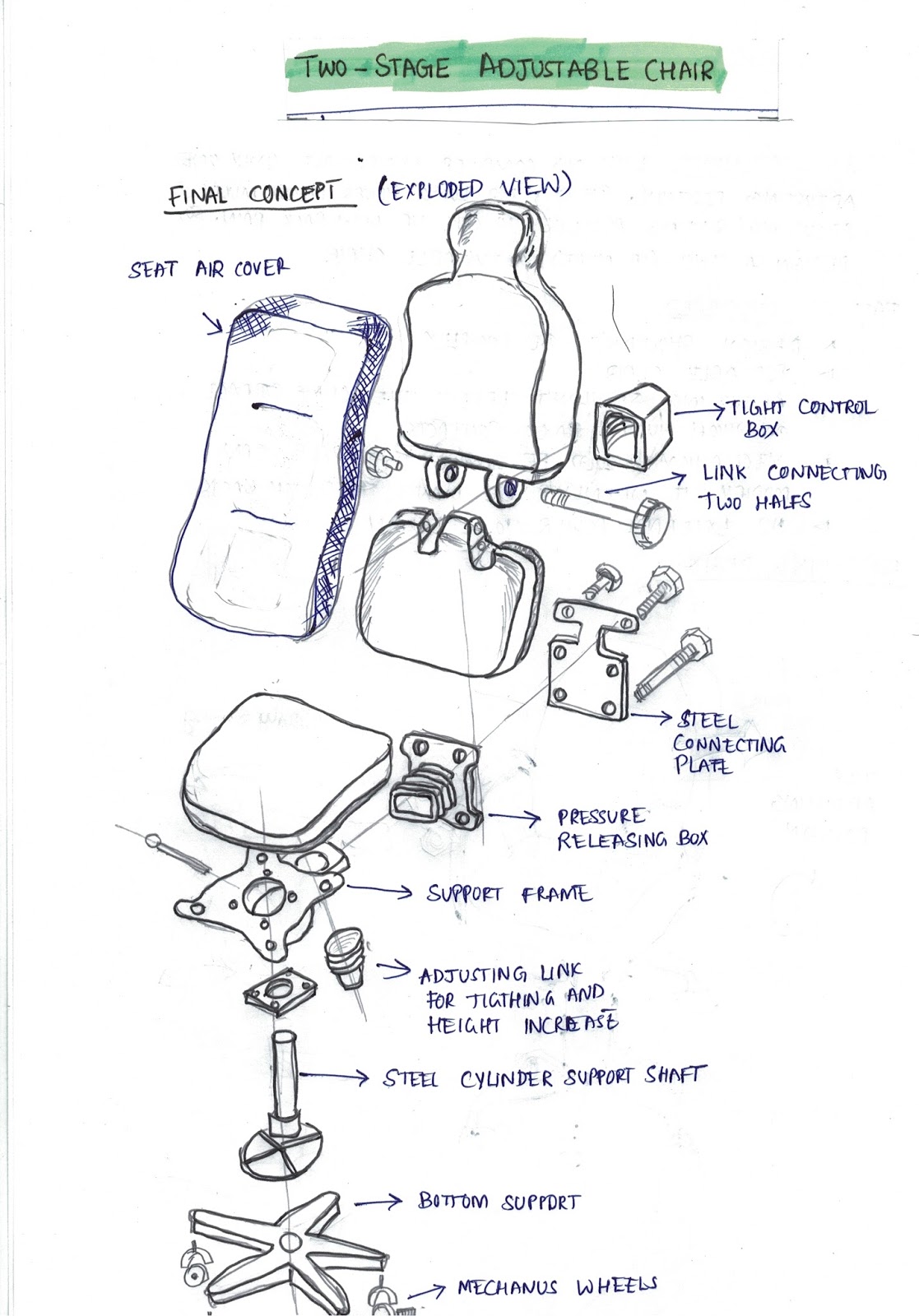
    Tips for Exploded views drawing


    Hi,

    I got a couple of comments on this blog asking to deal with Exploded views. So, today, I will be covering on some tips for exploded view drawing. Note that these topics are not at all required for UCEED students, so they are not advised to go through this or any of sketch/design related post as of now. CEED and NID students would find this helpful. 

    Before explaining exploded view, let me introduce you with assembly drawing, the most common term for mechanical engineers. 

    Many of the products in our surroundings are made of several small parts. Take the example of a Pen. A typical pen is a combination of rifle, outer top case, outer bottom plastic/metal case, cap and a holder to the cap. A combination of these we call as a pen, and representing the parts together intact in their working position is termed as 'Assembling' or 'Assembly drawing'. 

    Exploded view is quite opposite of assembling. Although the view should show all parts in unassembled part, the parts are not intact, meaning they will be shown separately, which are ready to be assembled. Again, let us take the example of a simple bolt-nut combination with a washer in between, as shown in the below image.


    Clearly, the above product is an assembly of three parts, viz. bolt, washer and nut. (If you're not able to identify the three parts, check the below image). As indicated by the blue lined arrow in the above image, the two parts (nut and then washer) has to be moved in the direction in order to disassemble it (along the axis indicated by red line in the image). The separated parts would look something like below.  


    The above picture could be considered as exploded view, since it clearly specifies the individual parts in their assembling positions. If we undo the process, I mean slid the washer and nut along the axis of movement (red line), then it will get assembled, right? This is a proper way of representing.

    However, people often do the mistake the showing parts in different directions/axis not in-line with the assembly. For example, in the above image, we know that the washer and nut should lie along the red axis line to be assembled, now consider the below image 


    Both the parts are on the other side of the bolt face, and if we try sliding it in the axis direction (along red axis as shown by blue arrows), we cannot assemble it, so, this is not a good way of representing. 

    Also, check the below image, 


    The axis of the two parts (green line) are not in line with the axis of the base part (bolt - red line), and so any movement of the nut/washer will not end in assembly, except you take it from green axis and place it in red axis. So, this also cannot be considered as a good exploded view. Now, check the below image which again violates and cannot support assembling of parts to form a single product with a single slide.


    With the above simple example and several set of images, I hope you now got an idea of how actually to represent exploded views. Individual parts (that forms the complete product) has to be shown apart from the base part, such that they are inline (along the same axis) while during assembly. 

    Below design is my solution to CEED 2009 product design problem in which we have to design a multi-purpose walking stick for the elderly, complete design and detailed discussion are available in this link


    For the above design, one possible exploded view could be drawn as below


    Although, I could've showed exploded details of more features/parts like the compass, mp3 player, switch, LED light in the top front as well as at the bottom etc, still it is valid since, whatever separate parts that I've shown including the screw, they were placed at the proper place in the proper direction.   

    Below, is one more design question from CEED 2013 solution to Part B question paper, in which we were supposed to design a mop that will allow cleaning in nuke and corners of the home. 


    For which, one possible exploded view could be 


    Another example design (exploded view) that I did as part of My portfolio with tips and guide


    Hope, you can now deal with exploded views easily. For more examples, just go through google images and type for any specific products exploded view say pens.


    22 September 2016

    Weekly time table (strategy) for CEED preparation


    Hello all

    Please note that there is no universal strategy applicable for everyone. Strategy and preparation level varies from person to person based on their existing abilities (proficiency in a field), how much time to spend everyday, their status (completely dedicated or partially preparing and also aiming for other exams), their ease of understanding/grasping topics, their ability skills and so on. So, it all depends on personal capabilities, but this timetable will be helping those who need guidance or a systematic approach of preparation.

    Having a reference time table might give you some idea of what topics to be studied, how much time to be spent for the topics, how length they are, your status/level for that topic and most importantly it will help as a check list to ensure that you don't miss any topic being unprepared. 

    The first strategy/time-table is for those who are average or below average at sketching/ drawing etc

    The second strategy is for those whom are above average or very good at sketching

    Kind note:

    1. I've included numbered labels for the Design part of CEED (Part - B), so that I don't have to repeat them every time in the schedule. I've given two Strategies for relevant people related to Part B (design part), but GA time table will be common for both the strategies
    2. You might be the best judge to know your abilities, shortfalls and the need for topic improvements, so adjust the given time table accordingly and go on your phase, that best suits you. Below timetable might only act as a reference :)

    The following topics and their respective Labeled numbers will be used in the schedule given below.

    ------------------------------------------------------------------------------------------------------------
    (Label - Topic)

    0 - product Design/Industrial Design
    1 - Visual Communication, Poster, Logo
    2 - Animation, Story board making, comic strips/frames
    3 - Story writing, Story write-up given some characters, picture composition - story writing by looking at a scene/image
    4 - Creative use of items - waste/reusable
    5 - Problem identification given a scenario, finding Factors, design idea proposal for the prob.
    6 -  Sketching, Line drawing, Exploded view/shape, composition, part view
    7 - Shading/rendering
    8 - Human/animal sketching line/object sketching
    9 -  Ideas of using products and applications (like use of invisible fluids etc)
    10 - Fault finding in existing products/designs/sketches
    11 - Visualization and Imagination ques.
    12 - Draw things/products/designs/human/animal from imagination
    13 - Draw by copying/ replicating/ seeing existing images/ products/ scenarios/ scenes/ designs etc
    14 - Study on latest technology, products, design ideas etc
    15 - Ideas from others in social/print media say in blogs, FB, Pinterest, behance etc
    16 - Sketch practice
    17 - Previous years part B practice; going through questions to understand the nature
    18 - Geometric/solid manipulations, transformations, views
    19 - Perspective/Vanishing point drawings/study

    ------------------------------------------------------------------------------------------------------------

    Important Note (for CEED Design; Part-B):

    1. Going through existing products/design/frame/others ideas is very important, likewise finding faults and coming up with your solutions is always a good designer practice (at least in my view)
    2. Carefully understand the requirement of the design questions - What they asked or looking for
    3. Mind the evaluation criteria before attempting/solving any design question
    4. You need to have a fair idea on existing products and their technology. So, I've included a topic/section with this heading in the timetable
    5. Sketching is imp. but design idea is the first important criteria to be considered, that's why I've given greater emphasis on how you can culminate the process of idea generation by way of various practices listed in the Labels/topics 

    ------------------------------------------------------------------------------------------------------------

    STRATEGY - 1 (Only Design Part)

    Level : Below average in Sketching

    -------------------------------------------------------------------------------------------------------------

    Month : September
    • 3rd week - 6 (line drawing), 13, 5, 19 (line drawing)   
    • 4th week - 4 ,8 , 10, 15, 13, 17, 6, 11 (Line drawing), 14, 18

    Month : October
    • 1st week - 3, 12, 17, 8, 10, 6 (sketch/Line-drawing), 0, (1 or 2 or both), 18, 19 
    • 2nd week - 10, 16, 15, 9, 6 (sketch, exploded view), 5, 0, 11, 12, 19
    • 3rd week - 3, 10, 9, 5, 0,  (1 or 2 or both), 4, 15, 18
    • 4th week - 17, 8 (little), 6 (sketch/exploded view), 0, (1 or 2 or both), 4, 10, 12, 14, 15

    Month : November
    • 1st week - 17, 16, 8, 9, 7, 5, 11, 12 (little), 14, 19
    • 2nd week - 10, 16, 7, 0, (1 or 2 or both), 14, 15
    • 3rd week - 3, 10, 9, 7, 11, 12, 5, 15, 18
    • 4th week - 16, 12, 18, 19

    Month : December
    • 1st week - 16, 12, 17 (just overview, mild practice)

    ------------------------------------------------------------------------------------------------------------

    STRATEGY - 2 (Only Design Part)

    Level : Above average (good) at Sketching

    -------------------------------------------------------------------------------------------------------------

    Month : September
    • 3rd week - 5, 10, 11,, 14, 15, 18
    • 4th week - 0,  (1 or 2 or both), 4 , 5, 17, 18, 19

    Month : October
    • 1st week - 0,  (1 or 2 or both), 3, 4, 5, 9, 18, 19
    • 2nd week - 4, 9, 10, 11, 12, 14, 15, 18
    • 3rd week -  0,  (1 or 2 or both), 5, 6, 11, 19
    • 4th week - 0,  (1 or 2 or both), 3, 8, 9, 10, 12, 15, 18

    Month : November
    • 1st week - 3, 4, 5, 6, 10, 14, 15, 19
    • 2nd week - 0, (1 or 2 or both), 6, 7, 11, 10, 15, 17, 18
    • 3rd week 0, (1 or 2 or both),, 3, 4, 12, 17
    • 4th week - 18, 12, 10, 15, 4

    Month : December
    • 1st week - NIL

    -------------------------------------------------------------------------------------------------------------

    GA Study Strategy (applicable for all)


    GA study includes verbal and verbal topics. 
    Since most of you can have access to aptitude and reasoning books, cost of which is comparatively less than any NID/UCEED/CEED books, I, therefore, list out the topics from those books.  I will list out the topics with their ranking in brackets. A very high rank (high being 5) means you are advised to prepare to the full for that topics, and a very low rating (low being 1), means you are advised not to spend much time on that and any rating in between means you are advised to give importance accordingly (time).

    Verbal Reasoning
    • Syllogism (2)
    • Logical Sequence of Words (2)
    • Blood Relation Test (1)
    • Series Completion (2)
    • Cause and Effect (2)
    • Dice, Venn Diagrams (3)
    • Cube and Cuboid (2)
    • Analogy (2)
    • Seating Arrangement (3)
    • Character Puzzles (4)
    • Direction Sense Test (5) 
    • Arithmetic Reasoning (3)
    • calendar (1)

    Non Verbal Reasoning
    • Series (4)
    • Analogy (4)
    • Classification (4)
    • Analytical Reasoning (5)
    • Mirror Images & Water Images (2)
    • Embedded Images (2)
    • Pattern Completion  (5)
    • Figure Matrix (3)
    • Paper Folding (5)
    • Paper Cutting (5)
    • Rule Detection (5)
    • Grouping of Images (3)
    • Shape Construction (2)
    • Image Analysis (5)
    • Cubes and Dice (5)

    -------------------------------------------------------------------------------------------------------------

    Month : September
    • 3rd week - CEED/UCEED Mock-test/previous paper test (to get hold of pattern)
    • 4th week - GK on  art history, renaissance, designers, famous paintings/works, aptitude on images/math, mensuration, non-verbal reasoning 

    Month : October
    • 1st week - Perspective study, vanishing point concepts, practice/test on ability tests, IQ ques, reading and paragraph comprehension, GA on authors, art history, renaissance, mechanism and everyday usage things working, basic concept behind that, CEED/UCEED Mock-test/previous paper test, non-verbal reasoning
    • 2nd week - print/color media study, India culture, animation study, logical arrangement of words, illusions, pattern analysis, pictograph puzzles, aptitude on images/math, mensuration, odd-man-out type ques, verbal reasoning  
    • 3rd week - paragraph comprehension, Architectural concepts, mechanism and everyday usage things working, basic concept behind that, pattern analysis, aptitude on images/math, CEED/UCEED Mock-test/previous paper test, verbal and non verbal reasoning
    • 4th week - GK on painters/paintings, designers, famous persons, facial expressions, Mathematical aptitude, image based aptitude ques that improve observation/visualization and imagination skills, pictograph puzzles, mensuration/math aptitude, CEED/UCEED Mock-test/previous paper test

    Month : November
    • 1st week - ability tests (identifying pattern in a given set), verbal reasoning, math aptitude, solid geometry/projections, CEED/UCEED Mock-test/previous paper test, GK on India culture, 
    • 2nd week - Solid/image manipulation, geometry etc, GK on materials, typography, font, Architecture, mensuration, odd-man-out type ques,  non verbal reasoning revision
    • 3rd week - latest products, authors, architecture, video/media, animation,  math and image aptitude revision and practice, ability practice, pictogram puzzles, color schemes practice, CEED/UCEED Mock-test/previous paper test,  environmental awareness, Paragraph comprehension revision
    • 4th week - English verbals, meanings, synonyms and antonyms,, revision on painters/paintings, designers, famous persons, India culture, art history,   animation terms, Mock tests or previous year papers (as many as possible), CEED/UCEED Mock-test/previous paper test

    Month : December
    • 1st week - revision on GK: art media, colors, designers, font, typography, photography, logos, authors, architecture, video,  renaissance,  CEED/ UCEED Mock-test/ previous paper test

    -------------------------------------------------------------------------------------------------------------
    Hope this comprehensive time-table helps you prepare well!

    If you feel like some topics are uncovered in the above weekly plan, please do comment here so that others would also know. 

    All the best for your start :)


    25 December 2015

    GA on Designers for CEED, UCEED and NID

    You are here UCEED >> GA on Designers for CEED, UCEED and NID
    -----------------------------------------------------------------------------------------

    Famous Logo Designers

    • Ruth Kedar - Google logo designer
    • Paul Rand - IBM logo designer
    • Herbert l Lubalin - 
    • FedEx logo designers - The earliest logo of Federal Express (FedEx) was created by Richard Runyon and the current version of the FedEx logo was designed by Lindon Leader of Landor Associates. (Thanks to the correction and update by Priyanka Jadon)
    • Wally Olins - Orange logog designer
    • Bob Gill - Gill has designed for Apple Corps records, Rainbow Theater, Universal pictures, queen and High times magazines and the United Nations.
    • Chermayeff and Geismar - Xerox logo designer
    • Rob Janoff - Apple and Intel logo designer
    • Marva Warnock - Adobe logo designer
    • Indian Rupee sign - D. Udaya Kumar
    • Swachh bharath logo - Anant Khasbardar of Kolhapur
    • NID logo - Adrian Frutiger, 
    • Sudharshan Dheer - Indian Iconinc Graphic Designer - Author of "The World of Symbols/Logos & Trademarks-India"
    • His works - design in india-1 - design in India - 2
    • Rohit Bal - 'India's master of Fabric and Fantasy'

    A very very good webpage for Logo collections (again thanks to Priyanka for bringing this to us) - Famous Logos

    Online Logo quizes 

    quizes 1

    Online quiz-2

    List of Indian famous graphic designers wiki


    Further (free time) study 

    famous designers from 99 design

    9 inspiring graphic designers

    50 designers you should know


    Top indian Textile/Fashion Designers list


    • Ritu Kumar, 
    • Rotu Beri, 
    • Wandel Rodricks, 
    • Abu Jani 
    • Sandeep Khosla, 
    • Manish Malhotra, 
    • Manish Arora, 
    • Rohit Bal,
    • Rina Dhaka, 
    • Tarun Tahiliani, 
    • JJ Valaya, 
    • Meera Mehta, 
    • Jadunath Supakar, 
    • Raghavendra Rathore, 
    • Neeta Lulla
     
    List of famous textile designers around the globe (go through the names) 

    Indian Famous Photographers


    • Anish Bhaseen, Siddhartha Joshi, Ritam Banerjee, 
    • Hashim Badani, Vikram Bawa, Subhash Chandra, 
    • Soni Vivek, Samar Virdi,  Purplekarma, Ujjwal Saxena, 
    • Benu Sen, Prabhuddha Dasgupta, Raghu Rai, 
    • Gautam Rajadhyaksha, Raghubir Singh, Anand Sharan, 


    For a list of Famous Architects - check the end of this page to get the list


    Additional general topics


    35 Indian car brands and logos  


    famous artists/painters with their pics 


    Free time study


    25 most famous popular sculpture in the world

    42 famous statues around world  


    I don't want to exhaust you with too many info. Probably you will get confused, so that's why I will stop adding more materials on this page. But in case if you feel like you need more info, just let me know by dropping comment below, so that I will consider adding more of these kind ........ further.......later.

    Hope this helps :)


    14 November 2015

    Answer key for CEED 2016 Part - A mock test -1

    -------------------------------------------------------------------------------------------

    This is the anser key to CEED/UCEED 2016 Mock test -1, If you haven't checked the questions, yet, I strongly recommend to go through the actual questions, try to solve them, and them come here to check the answers. Here is the actual question set - 2016 Part - A practice mock test - 1

    1) Solve this

    ans) A

    2) What is the correct option for a Tetrahedron

    a) Face = 4, Vertex = 6, Edges = 4
    b) Face = 6, Vertex = 6, Edges = 6
    c) Face = 4, Vertex = 4, Edges = 6
    d) Face = 6, Vertex = 8, Edges = 12

    ans) C

    3) Figure shows a Bolt and Nut combination, if you have to rotate and tight it using your left hand in the same orientation as shown as given in the figure, which option is correct


    a) rotate clockwise direction
    b) rotate anticlockwise direction
    c) any direction
    d) None

    ans) a

    4) Which type of mirrors are used 'as wall mirrors' or 'dressing mirrors'

    a) convex
    b) concave
    c) cylindrical
    d) plane

    ans) d

    5) Below picture shows a famous painting "Three girls" made by


    a) Rabindranath Tagore
    b) Amrita Sher Gil
    c) Manjit Bava
    d) Lalita Lajmi

    ans) b

    6) The Great Sphinx Of Giza, Egypt is made from


    a) Clay 
    b) Rock
    c) Limestone
    d) Plaster of Paris 
    e) Wood

    ans) c

    7) Famous book "The God of small things" was written by

    a) Jhumpa Lahiri
    b) Salman Rushdie
    c) Amish Tripathi
    d) Arundhatti Roy

    ans) d

    8) Which of the following are true related to Paint brush (select multiple)

    a) Two basic types of bristles: natural and synthetic
    b) Only one type: made from animal hair
    c) synthetic bristles are made from nylon
    d) synthetic bristles are made from Polyster
    e) Natural bristles are made from hog or badger
    f) b,e
    g) a,c,e
    h) a,c,d,e

    ans) h

    9) What reasoning fact can you give after judging the below picture

    ans) Pain-less operation

    10) Figure shows a solid and its projection in three different views, a,b,c, represents


    a) front view, top view, right side view
    b) left side view, top view, front view
    c) top view, front view, left side view
    d) top view, front view, right side view

    ans) d

    11)
    All the flutes are instruments.
    All the harmoniums are flutes.

    what can you derive from the above two sentences ?

    ans) All harmoniums are instruments

    12) count the number of squares in the given figure (source: UCEED 2015 paper)


    ans) 37

    Check the below images for better understanding, note the blue shapes fitted to indicate the square counted.
    Handle these type of questions as follows:
    1. First count the big squares, write it down for sure, 
    2. then count next lesser sized squares, write it down, and so on. 
    3. Don't stick to principles like 'Symmetry', even in symmetry images, there might be squares (or any required shape) derived from the two symmetry.


    Squares -> 1 (in the center) + 1x(2 - for both sides) = 3


    Squares -> 9 x (2 - for both sides) = 18

    Squares -> 8 x (2 - for both sides) = 16

    Total squares -> 3+18+16 = 37

    13) The given figure is made of letters L,T,H,I,E and F, set in different orientations. Find the total number of
    occurance of capital letter T in the figure. (source: UCEED 2015 paper)


    ans) 7

    14) Count the number of surfaces for the given picture


    ans) 13

    3+3+2+3+1+1 = 13

    check how to solve similar questions here - solving for no. of faces on solids
    Also see -  working with geometric shapes

    15) A square paper is folded twice and four small triangular cuts are given as shown in the picture Identify the correct unfolded pattern 


    source  

    ans) 2nd pattern

    16) Which of the following are Image formats

    a) ANI, CAL, PBM, PGM
    b) BMP, GIF, IMG
    c) WMF, JPG, JPEG,
    d) FAX, PCB, PPM, RAS
    e) a and d
    f) All

    ans) f
    Check all the image formats list

    17) Which of the following is/are types of pollution

    a) Light Pollution
    b) Noise Pollution
    c) Visual Pollution
    d) Radioactive contamination
    e) Soil contamination
    f) Visual pollutions

    ans) a,d,c,d,e (all)

    18) Canon released the highest pixel camera recently, select the correct range of it's MP

    a) 30-40 megapixel
    b) 20-30 MP
    c) 65-70 MP
    d) 50-55 MP

    ans) d

    19) A machine produces 100 units of product per minute. If 24 units of product are packed to the case, how many cases can be filled in one hour by the machine? 

    A. 125
    B. 250
    C. 500
    D. 2,500
    E. 6,000 

    ans) B 

    Explanation:
    If 100 units are produced every minute, then 100 units x 60 minutes = 6,000 units are produced every hour. 6,000 units per hour / 24 units per case = 250 cases per hour. The correct answer is B.

    20) Identify the correct pattern


    ans) B

    21) Shown below is a belt and pulley arrangement. How many pulleys are rotating clockwise


    ans) 5

    22) Below shows a image of a man in running position, select the next four set of movements of the human in order


    a) 2, 1, 3, 4
    b) 3, 1, 4, 2
    c) 1, 2, 4, 3
    d) 4, 1, 3, 2

    ans) d

    Learn more about - Animation and step by step movement

    23) Who among the following, doesn't belong to the list of 'famous Graphic designers'

    a) Sachin Bavkar
    b) Satish Gurera
    c) Sujata Kesavan
    d) Akshr Pathak
    e) all
    f) none

    ans) f

    24) If teapot A holds 32 ounces of tea, about how many ounces does teapot B hold?

    a) 64
    b) 0
    c) 16
    d) 48
    e) cannot determine

    ans) 16 ounces (about half of pot A).

    The amount of tea that can be kept within each pot is determined by the height of the spout opening. The tea level cannot rise above the spout opening since any extra tea would merely spill out from the spout.  A simple visual estimate would conclude that the spout of teapot B is approximately half the height of that of teapot A, therefore providing only half of the capacity, or 16 ounces.

    25) Which two of the four images are same


    a) a,c
    b) a,b
    c) b,d
    d) (a,c) and (b,d)
    e) all four match to the same pattern
    f) none

    ans) d

    26) Left image shows four cut papers, which when joined will form which pattern


    a) A
    b) B
    c) C
    d) D

    ans) B

    27) Identify the famous personality 


    a) Sir C.V.Raman
    b) Jagadeesh Chandra Bose
    c) Subash Chandra Bose
    d) Arya Bhatta

    ans) b

    28) Following image is a strange design made by the famous company "Porsche".  Identify the product use
    a) Table and night lamp
    b) Hot water and tea maker
    c) Hookah
    d) voice speaker

    ans) c

    29) Select as many (source: UCEED 2015 paper)


    ans) C,D

    30) Figure shows what is called "Archimedes screw" that is principally used to raise water. In order to raise water , the shaft with blades should rotate


    a) Cloclwise
    b) Aniclockwise
    c) both directions lift water

    ans) a

    31) which among the following comes under recycled packing materials

    a) Bubble wrap
    b) Paper board
    c) Corn starch
    d) Glass
    e) none

    ans) a,b,c,d

    32)
    In all cultures, gestures are used as a form of communication, but the same gestures may have very different meanings in different cultures.

    a) No two cultures use the same gestures.
    b) One gesture will never have the same meaning in two cultures.
    c) A person from one culture may misunderstand the gestures used by a person from another culture. 

    ans) c

    33) The following image is 
    a) A photogragh
    b) edited image of photoshop
    c) made by oil painting
    d) Acrylic painting
    e) Pastel work

    ans) c

    A pure oil painting!
    More Painting Resources : on wiki page, most popular painting styles

    34) The much anticipated movie "The Jungle Book" to be released in 2016 is directed by

    a) Justin Murphy
    b) Nick Park
    c) Brad Bird
    d) Jon Favreau 

    ans) d

    35) Below image shows a cardboard box, select the best option


    a) 4-point perspective
    b) 1-point perspective
    c) 11-point perspective
    d) Picture not in perspective

    ans) d

    Very good collection of - perspective and non-perspective images

    An example image showing how to evaluatre 'out of persepctivness' in the given image. Note that the thing you need to do is to extend the edges of the object till extensions meets at some points. These meeting points are termed as 'Vanishing points'. If there are two such points, it's called Two-point persepctive image (2PP), if three, it's 3PP. In an given image, some objects might be wrongly sketched/showed which will be out of persepctive.


    36) Figure shows a palace in Russia, state the material used


    a) Brick
    b) Limestone
    c) Marble
    d) Italian stones
    e) Cement

    ans) c
    See more - Architectural guide

    37) Which among the following is/are (select as many) not a style of Architecture in India

    a) Gadag
    b) Maru-Gujara
    c) Nagara
    d) Badami
    e) None

    ans) e
    See more - Architectural guide


    As you can seen, I have included a good number of UCEED 2015 questions, just to remind you the similarities in the pattern of both the exams, in fact I guess the level for UCEED Part A is some steps ahead to the level of CEED! So, those preparing for CEED are recommended to practice UCEED previous papers (as well as the mock tests that I dealt in this blog) to strengthen your practice and mathematical as well as design abilities. I knowingly neglected asking questions related to culture and other GA related, hoping that you are aware of them, or you can find them in previous mock tests.

    More Mock tests for your practice


    Part-A and Part-B practice exercises (*)


    Hope this helps, All the best ........