Showing posts with label CEED practice. Show all posts

12 January 2021

CEED last few days preparation priority list

 List of topics to prepare and to skip (2021 update)


Part B

  1. Avoid spending hours for sketching of one particular question.
  2. Problem identification (given a product or scenario) and creativity are the the two area which you should continue till the last day. You don’t have to sketch, just list down the identified problems or quickly scribble the creativity part.
  3. Do quick scribbling of line sketching and do a few situation based exercises too, like at least two situations in just one half an hour!
  4. Don’t spend more than three hours per day for part B, if you have the whole day for your preparation.

Part A

  1. Skip current affairs and GK
  2. Skip Materials and Manufacturing process study
  3. If you have started your preparation recently - skip design awareness (like culture, designers, painters etc. - from here on let’s term this as GA)
  4. If you have been preparing for a while, esp. the image based and non verbal part and haven’t touched GA part then quickly revise the following GA topics
    • Painting, state wise painting, art and all.
    • Quickly go through colour theory
    • Famous designers,
    • Quickly about photography
    • Based on leftover time, plan to cover any other GA topics that you felt imp.
    • Revise and practice some samples of nonverbal and image involved aptitude questions, including ability questions
    • Practice at least one previous paper with a time limit. It’s fine to cross check the answers but never ever try to estimate the score or check if that score is sufficient or not! Remember, whether you prepare or not your positive attitude and confidence are very important and if you keep comparing scores you might loose your confidence....for no reason. So be smart!
  5. If you are not ready with non verbal too (just started), then do the following
    • Skip current affairs
    • Skip entire GA including about designers, materials etc. No need to touch any and it’s absolutely ok, especially if you feel you can pick up some score from the below preparation
    • Practice wholly (apart from the sketching) on
      • Abstract tests
      • Solids and their manipulation (folding, unfolding, different views, counting no. of surfaces etc.)
      • General, mechanical and spatial ability
      • Deductive reasoning
      • Odd man out series
      • Revise basic math formulas (check the formulas in this video and they are more than sufficient)
      • Skip signs, symbols etc,
      • Skip paragraph comprehension (just face them during exam)
      • Base on time availability you may plan to cover the utmost imp GA topics as listed above
  6. Again, Practice at least one previous paper with a time limit. It’s fine to cross check the answers but never ever try to estimate the score or check if that score is sufficient or not! Remember, whether you prepare or not your positive attitude and confidence are very important and if you keep comparing scores you might loose your confidence....for no reason. So be smart!

That’s it...


All the best, 
Your bro,
Bhanu. 

18 August 2019

Collection of CEED exam study materials


Someone was asking me to help in finding and easy navigation to a specific topic. Since the topics are wide and many, I've tried my best to segregate them in order - for easy navigation, along with a brief note of the content of the links. Hope this helps.


Complete CEED related SYL blog links download PDF (2020 update)

Before we see the materials, below is a brief list of syllabus for CEED Part A, just for your quick reference
  1. Visual Communication - Logo's, signage, advertising, packaging, fonts etc.
  2. Animation Design - Movement observation, comic strips, visuals etc.
  3. Product Design - Latest and newest products and trends, current products etc.
  4. Automobile Design - Aesthetics, manufacturers and plants etc.
  5. Digital (applied to almost all the fields) - Photography, color coding, displays, printing etc.
  6. Observation (Basic designer skill) - Mirroring, textures, evolution (past to present), isometrics and geometry, tessellations, shadows and more.
  7. Architecture - Sculpture, monuments, materials etc.
  8. General awareness - Engineering ability, materials, culture of the country, famous personalities and their works, instruments, animals etc.

  1. Photography terms, methods and general guide
  2. Guide to Color and video technology
  3. Artistic tools, drawing terms, sculpture
  4. Architecture guide (complete set of architecture/monuments/stupas etc. collections of SYL).
  5. State Painting and Painters
  6. Typography
  7. Illustrations
  8. Musical Instruments 
  9. Guide to solving animation type questions, step-by-step animation movement type questions and how to solve them
  10. Logo's of reputed institutes, automobiles, and signage (signs, symbols and their interpretations)
  11. About India
  12. Materials and manufacturing process (common materials used and the manufacturing process for them)
  13. Evolution of products
  14. Folding and unfolding of solids (Tessellations)
  15. Solving 'number of faces' type questions
  16. Questions on images and geometric objects
  17. Odd man out series 
  18. Direction sense test
  19. Illusions
  20. Numerical and aptitude questions
  21. Tips for solving inductive and logical reasoning questions
  22. Some Deductive, Inductive and verbal reasoning
  23. Convex and concave mirroring
  24. GK on famous authors, PMs, architectural styles bank logos, famous monuments, wonders and finalists etc.


Link 2: CEED Subjective help (Part B help)

This link contains:
  1. Links to sketching/drawing, perspective drawing, tips to exploded views, shading/detailing works etc. 
  2. Guide to User Interface design (UI/UX)
  3. Guide to comic strip making
  4. Storyboard and poster making
  5. Picture Composition (writing a story given an image)
  6. Theory on Design thinking and Creative studies

Link 3: Non Verbal (Image-based questions for CEED) 

This link contains:
  1. Mathematical Geometry ( Types of views, how to visualize solids in all the sides)
  2. Basics of solid shapes
  3. Observation and visualization skills (tangram puzzles. mechanical and spatial ability, tessellations)
  4. Abstract tests, spatial and visual ability test 
  5. Rebus puzzles (pictogram puzzles) 

This link contains:
  1. Collection of famous logo designers, Indian fashion/textile designers, 
  2. Indian famous photographers
  3. Some logos
  4. Famous painters/paintings
  5. Olympic medal winners
  6. Prehistoric paintings and more


Link 5: Resource collections from UCEED page for CEED

Refer only the topics listed below for CEED:
  1. Guide on font with several online links
  2. Typography, visual iconography
  3. Intro. to mathematical solid shapes
  4. Famous paintings, painters, artistic media, art movements etc.
  5. Colors 
  6. General topics (paper sizes, dances, image formats, drawing terminology, perspective and non perspective works)  

Refer only the topics listed below for CEED:
  1. Non-verbal and Image reasoning 
  2. Go through the bullet points under the heading "Some facts"
  3. List of some famous epics of India
  4. List of Indian animators, famous photographers, women designers, renaissance poets
  5. List of Indian noble prize and oscar winners
  6. Plutchik-wheel of emotions


Link 7 - Some CEED Part - A materials

This link contains:
  1. Evolution of objects
  2. Something about materials
  3. A few GK 
  4. Color selection
  5. A few IQ tests 
  6. Sustainable and eco products


This link contains:
  1. CEED Part A previous papers (from 2012 to this years)
  2. Some solutions to CEED Part B (design, sketching, problem-solving etc.)
  3. UCEED previous papers solutions (from UCEED 2015 to latest) - UCEED solutions will help you for CEED Part A preparation as most of the syllabus is same (UCEED is tougher than CEED.
  4. UCEED sample practice papers
  5. CEED sample practice papers


This link contains
  1. Mock tests, samples and previous model papers for CEED.
  2. Mock tests, samples and previous model papers for UCEED (to be practiced for CEED too).
  3. Subjective practice questions


This link contains
  1. Collections of everyday design practice questions for CEED
  2. Solutions shared by me and some students for everyday practice questions
  3. Solutions to some CEED previous years design (Part B) questions
  4. Tips to solving some design questions.


Videos to help you


When to start making portfolio ? What to prepare for Part B


What to start? 
How to solve design aptitude, non-verbal, and Ability questions with examples


PART 16


Maths Basics for non-math background design aspirants


Counting number of surfaces on solids


How to start and what to practice for CEED


Find all videos here


Additional Resources


28 December 2016

CEED one month practice topics - quick list

(Updated with new strategy from 2021)

A very quick list of topics useful for one month CEED preparation.  

Before that I will answer the question that might be troubling you - 'Is one month sufficient?'. 

The straight answer is 'YES'

Just use the available time properly and stop having the questions
'what marks should I get?', 
'How may questions should I attempt?'
and more....
I considered suggesting some topics purely based on my view.

I suggest you to modify the below generic strategy and come up with your own strategy, which shall be best suited for you.....according to your abilities, speed, time availability and other commitments

Let's start being self dependent :)


Priority list


1) Sketching

If you have been practicing from a while then continue with the flow. If you are just starting then start by solving 2020 previous paper (or the most recent one)....Coz first you should understand the sketch questions type being asked. Once you understood, start practicing similar questions. 

The below strategies are suggested assuming that you have already practiced sketching basics like - line qualityperspective sketching, sketching minding form, shape, size, proportion etc. If you haven't and are starting a fresh, then you may want to practice general sketching to improve the above mentioned factors.

The topics that need immediate focus and can be continued until the first three weeks are
  • Scenario based sketching (given a scenario and the requirements and you are asked to show that) - like Q1 in CEED 2020 paper - if you have time then at least an hour. If no time then min 30 mins
  • Making form - like Q4 in CEED 2020 paper - take one or two ques each day and spend around 30 mins
Visual synthesis part (like Q3 in CEED 2020 paper) can be planned only for one week and that too on the third week (start two weeks before the exam and use only one week for this) - may be 20-30 mins per day if you've less time.
 
The below topics should be continued until the last day from the very beginning because these are very important!
  • Problem Identification (like Q5 in CEED 2020)  - if you have time then spend as much time, solve a minimum of 2-3 questions for which the problems needs to be identified
  • Creative thinking (like Q2 in CEED 2020) - take at least one question and try to solve. 
I've already listed many practice questions and you can use them or you can use use questions from any other sources that you have. But do practice as much as you can and improve quickly....


Check the below video on sketching Level required (sufficient) for CEED if you haven't yet 
(This will clarify, guide as well as prevent you from doing wrong practices since time is precious!) 


2) 
Next comes Part A practice, Following topics (that deals with visualization/imagination) are recommended first

Geometrical views, 
Projections, 
Solid manipulations, 
Visualization of solids (practice these very quickly)
Basically any type of questions dealing with images, solids etc., including the puzzles kind are recommended

How to Solve Design Aptitude, non verbal, and ability questions with clear explanation


3)
Mensuration (medium level) - topics that need the basic maths (trust me, no need to go for detailed mathematics, very very basics formulaes are sufficient. I've already covered them in this video. It will hardly take a few hours to memorize them.) Keep practicing this on daily basis by spending say 15-20 mins every day until u feel u are able to solve problems related to mensuration. 

This includes problems on (mostly the below are sufficient) 
Pythagoras theorem
Basic level - Area, volume,
Triangles,
Circles.

Check the video on Basic Mathematics formulas sufficient for Design exams


A snap from the video showing the basic formulas sufficient from mathematics


4)
Mechanical Ability, Spatial ability,

5)
Image Aptitude, 
Pictogram puzzles, 
Inference from pictures
Animation movement

6)
Pattern recognition from images

7)
Image observation (like identifying similar patterns in a set of patterns)

8)
Paper cuts

9) Reading/Paragraph comprehension (Very little - don't spend much time on this if you have already done some practice or if this is handy to you, but remember this topic is important for UCEED exam!)

And finally

10) GK/GA on 
  1. Art, painters - works of famous artists, ability to identify and recognise the works,  
  2. Renaissance
  3. Designers,  famous persons related to design
  4. Indian art history, Culture
  5. Photography and art media - terms, techniques, standards, 
  6. Color theory, Art and print media
  7. Architecture - significant/historical structures, persons, media, variants etc
  8. Logos (mostly in Indian context that too related to design institutes, governmental service sectors as well as cars, skippable if you have less time)
  9. Indian regional culture, literature, music, style etc 
  10. Materials (just overview if you have time else skip)
  11. English - (skip this, no need to spend time for this).
The first nine in the list above......you can start immediately, and skip the design GA initially. In the last week before the exam (or if you can cover up the above topics quickly.....then you can use the last two weeks before the exam) 

Or, if you feel that you need more time for sketching and the aptitude part of Part A then it is safe to skip some topics of GA. That's because not many questions are seen in CCED papers related to GK and/or design GA. 

Also, don't forget to attempt previous papers (including UCEED, NID papers) so as to keep a track of the time that you consume for answering the papers as well as keep yourself in pace with the time-bound answering.


Good luck :)
Bhanu


You may check my old video on 'CEED one week practice tips'.


21 December 2016

Tips for Exploded views drawing


Hi,

I got a couple of comments on this blog asking to deal with Exploded views. So, today, I will be covering on some tips for exploded view drawing. Note that these topics are not at all required for UCEED students, so they are not advised to go through this or any of sketch/design related post as of now. CEED and NID students would find this helpful. 

Before explaining exploded view, let me introduce you with assembly drawing, the most common term for mechanical engineers. 

Many of the products in our surroundings are made of several small parts. Take the example of a Pen. A typical pen is a combination of rifle, outer top case, outer bottom plastic/metal case, cap and a holder to the cap. A combination of these we call as a pen, and representing the parts together intact in their working position is termed as 'Assembling' or 'Assembly drawing'. 

Exploded view is quite opposite of assembling. Although the view should show all parts in unassembled part, the parts are not intact, meaning they will be shown separately, which are ready to be assembled. Again, let us take the example of a simple bolt-nut combination with a washer in between, as shown in the below image.


Clearly, the above product is an assembly of three parts, viz. bolt, washer and nut. (If you're not able to identify the three parts, check the below image). As indicated by the blue lined arrow in the above image, the two parts (nut and then washer) has to be moved in the direction in order to disassemble it (along the axis indicated by red line in the image). The separated parts would look something like below.  


The above picture could be considered as exploded view, since it clearly specifies the individual parts in their assembling positions. If we undo the process, I mean slid the washer and nut along the axis of movement (red line), then it will get assembled, right? This is a proper way of representing.

However, people often do the mistake the showing parts in different directions/axis not in-line with the assembly. For example, in the above image, we know that the washer and nut should lie along the red axis line to be assembled, now consider the below image 


Both the parts are on the other side of the bolt face, and if we try sliding it in the axis direction (along red axis as shown by blue arrows), we cannot assemble it, so, this is not a good way of representing. 

Also, check the below image, 


The axis of the two parts (green line) are not in line with the axis of the base part (bolt - red line), and so any movement of the nut/washer will not end in assembly, except you take it from green axis and place it in red axis. So, this also cannot be considered as a good exploded view. Now, check the below image which again violates and cannot support assembling of parts to form a single product with a single slide.


With the above simple example and several set of images, I hope you now got an idea of how actually to represent exploded views. Individual parts (that forms the complete product) has to be shown apart from the base part, such that they are inline (along the same axis) while during assembly. 

Below design is my solution to CEED 2009 product design problem in which we have to design a multi-purpose walking stick for the elderly, complete design and detailed discussion are available in this link


For the above design, one possible exploded view could be drawn as below


Although, I could've showed exploded details of more features/parts like the compass, mp3 player, switch, LED light in the top front as well as at the bottom etc, still it is valid since, whatever separate parts that I've shown including the screw, they were placed at the proper place in the proper direction.   

Below, is one more design question from CEED 2013 solution to Part B question paper, in which we were supposed to design a mop that will allow cleaning in nuke and corners of the home. 


For which, one possible exploded view could be 


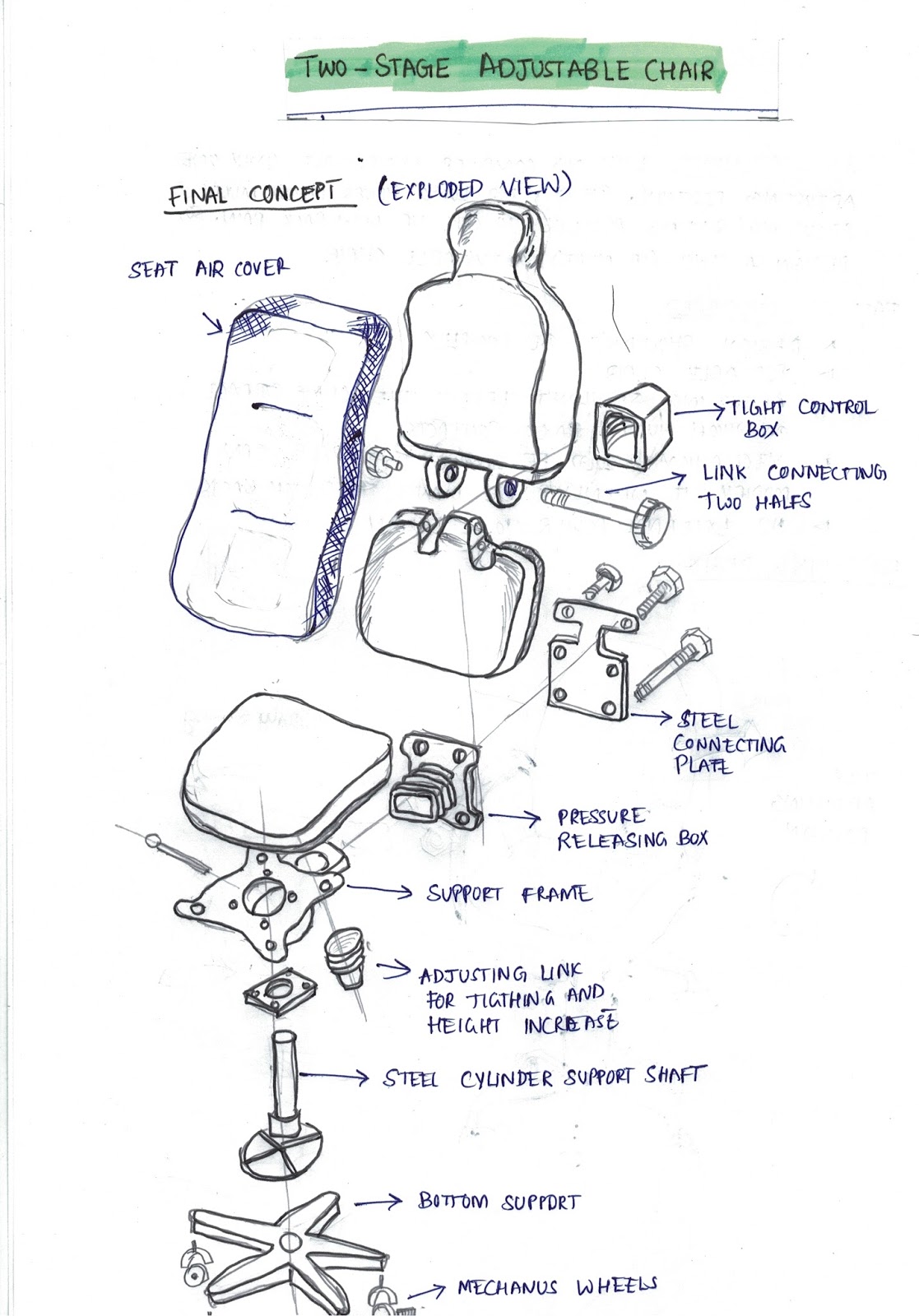
Another example design (exploded view) that I did as part of My portfolio with tips and guide


Hope, you can now deal with exploded views easily. For more examples, just go through google images and type for any specific products exploded view say pens.


28 November 2015

Answer key for CEED and UCEED Mock test 2016

you are here ....... Practice >> Answers to CEED and UCEED practice mock test - 2
----------------------------------------------------------------------

If you haven't attempted the questions yet, I would recommend you to first check post with ONLY questions and then come to check answers, then only you will come to know whether you're able to solve or not.

You can find the actual mock test here


1. Correct unfolded view of the solid is


ans) b


2. What are the common "Perceptual channels" (select as many)

a. Tactile
b. Communication
c. Auditory
d. Kinesthetic
e. Visual

ans) c,d,e
Auditory relates to spoken words, sounds etc (what is heard and said). Kinesthatics relates to Emotions, actions, movement, taste, smell ...... (something that is felt) Visual represents - what is seen like printed materials, fascial expressions, body language etc

3. Emotions, actions, movement, taste, smell ...... (something that is felt) represents

a. Auditory
b. Kinesthetic
c. Visual
d. Tactic

ans) b

4. When "Rule of thirds" is applied to a picture/image, then in many parts the picture/image will be divided

a. no divison
b. 3 parts
c. 6 parts
d. 9 parts
e. 3*3*3 = 27 parts

ans) d


5. Which of the following is/ARE considered "Impossible triangle"

a. Kanizsa triangle
b. Penrose triangle
c. Barmoda triangle
d. Color triangle 

ans) b

6. Select the correct basic types of "perspective" 

a. Angular persepctive
b. Linear Perspective
c. Aerial Perspective.
d. all

ans) b,c

7. The relation between h, d, a, where h = apparent height of object, a is the actual size, and d is the distance of the object is best given by

a) h = a*d
b) d = a*h
c) h=a/d
d) a = h*d

ans) c

8. The following image is ipads cover. Identify how many visuals represents Paris


ans) 14

Word Paris - 11 (including the word from the small projection left to the cover, might not be clearly visible, but it's design is same as the actual cover design showing the big tower, the word 'Paris' is obviously below the tower as in the right part)
Eiffel Tower -3

9. Which option represents the correct unfolded view of the given solid ? (select a,b,c,d)


ans) d

10. Identify to which brand(s) the following products belongs to


a. Sennhieser, apple
b. Samsung, Philips
c. Sony, apple
d. Beats by Dre, apple
e. Philips, Philips
f. Sony, Sony
g. Beats by Dre, Philips

ans) c
The first image is the sony's latest headphone entry "Sony MDR-100AAP", Second one is Apple's cheapest gadget - iPod shuffle. Both are my favorites :P

11. Light bulbs are usually filled with inert gas, which of the following can be used (multiple)

a. Nitrogen
b. Methane
c. Helium
d. Krypton
e. Argon
f. Xenon

ans) a,d,e,f

12. How many different colors are used in this image ?


ans) 8

13. How many font sizes are used in the visual given in (Q12)

ans) 10

14. How many times the following letters 'R', 'E', 'A', 'D' appeared in the visual given in (Q12)

ans)
R - 12
E - 13
A - 13
D - 4

15. How many triangles and semi circles (with different colors) are there in the given image


ans) 4, 2

16. How many different colors are used in the given image


ans) 6

17 - How many diff patterns are there in the given image


ans) 12

18. Select the types of biodiversity among the options given

a. Species Diversity
b. Operational Diversity
c. Genetic Diversity
d. Functional Diversity
e. Forest Diversity
f. Plant Diversity
g. Ecosystem Diversity

ans) a,c,d,g

19a.  How many triangles are possible in the given picture


a. 12
b. 9
c. 11
d. 10

ans) c

19b. How many intersection points (like A,B ....) are there, where exactly three lines are meeting

a. 6
b. 4
c. 7
d. 8

ans) a

19c. If E =C, both points are lie on the same place, then how many triangles are possible, and how many lines are sufficient to generate this pentagon image ? 

ans) 5 triangles and 10 lines

20. How many reptiles are visible in the below image


ans) 1 
Turtles, crocodiles, snakes, lizards and Tuatara are considered reptiles

21. Image shows a structure (links) in which bottom link (link joined by bottom two nodes) is fixed/pivoted to the ground. choose the correct option


a. The mechanism is rigid/static (cannot move)
b. The mechanism can move either left or right but to some angle
c. The mechanism can move either left or right
d. The mechanism is not stable, and might collapse with little disturbances

ans) a

22. For the given pulley system, if mass M2, goes down by 10 cm, choose the correct choice


a. Mass M1 goes down by 10cm
b. Mass M1 goes up by 10cm
c. Mass M1 goes up by 5cm
d. Mass M1 goes up by 20cm

ans) d
If the small pulley with mass M2 goes down by say a distance, then the rope surrounding the pulley has also moved by 'a' length, but it is on both sides, so the total rope length moved is '2a', and the mass on the other side moves in opposite direction to this direction

23. Figure shows a mechanism that helps to perform which action


a. Provide push force
b. Dig earth
c. Acts as a elevator mechanism
d. he mechanism cannot have motion

ans) c

This is the famous mechanism commonly used in elevators or anything that helps to rise things.

24. How many marble pieces are used to make this pattern ?


ans) 32

25. Match the following cultural dance with the state to which it belongs to

a. Kathakali     1. Gujurat
b. Dandya       2. Rajasthan  
c. Bhangra      3. Maharastra
d. Bihu           4. Punjab
e. Chau          5. Kerala
f. Ghoomer     6. Assam
g. Dindi          7. West Bengal

ans) (a,5),(b,1),(c,4),(d,6),(e,7),(f,2),(g,3)

26.  Identify to which brand the following logos belong to


ans) Mustang, infiniti, Aston Martin, Citreon, Acura, 

27. How many non-color pencils can be spotted in the picture ?


a. 17
b. 20
c. 16
d. 13
e. 21

ans) 13

28a. Which type of materials is/are recyclable completely or partly (select as many)

a. Coke bottles
b. Coke tins
c. Use and throw tea/juce cups
d. Tennis ball
e. Foam plates
f. Incandescent light Bulbs,
g. Card board boxes tarnished with food
h. Aquafina water bottle
i. CFL bulbs

ans) a,b,c,d,e,g,h
The corrugated cardboard in pizza boxes is itself recyclable, but like any paper product, cardboard is no longer recyclable once it is tarnished with grease or food.
Yes, tennis balls ARE recyclable. 
Incandescent bulbs can be thrown in the black trash bin, but fluorescent, compact fluorescent lamp (CFL) and light-emitting diode (LED) bulbs are considered household hazardous waste and must be taken to a Solvents, Automotive, Flammables and Electronics, or SAFE, center for disposal because they may contain mercury.
Both fluorescent and compact fluorescent (CFL) light bulbs use considerably less energy than incandescent and halogen bulbs. Since all types of fluorescent bulbs contain mercury, which is toxic, they are not fit for disposal in the garbage.


28b. Plastic drinking water bottles are made from

a. PVC
b. Polyethylene 
c. Polycarbonate
d. Polyethylene terepthylene

ans) d, 
famously called PET, The current national recycling rate for PET is 20%

29. Select the correct order for the following shown instruments numbered a,b,c


a. Sarod, Sarangi, Sitar
b. sarangi, sarod, sitar
c. sitar, sarod, sarangi
d. sarod, sitar, sarangi

ans) b

30. How many intersections (one line crossing or meeting another line) are possible in this image


(additional exercise: If lines AB, BC, CD are removed, then how many triangles are possible)

ans) 44
At corners/noded - 6 (each having 5 intersections)
Two line intersection (inside the hexagon other than center) - 12(each contribute to 1 intersection)
Three lines at center - 1 (counts to two number of intersections)

31 Check this car, and identify the correct option to which it belong to


a. Dodge Challenger
b. Ford Mustang
c. Caroll Shelby
D. Citreon DS4 HDI Sport chic

ans) b

32. Identify to which organizations the following logos belongs to


ans) WHO, ISRO (without name)

33. How many lines of clear waves (no partial visible waves) are
clearly visible in the picture (don't count half waves)


a. 22
b. 24
c. 21
d. 26
e. 27

ans) c

34. How many times letter E is flipped downwards ? (from UCEED)


ans) 3 times

35. In color triangle, how many primary colors are used as an additive combination to make the triangle

a. 4 colors
b. 1 color
c. 3 color
d. Rainbow colors

ans) 3  
Three primary colors—red, green, and blue—is located at a corner of the triangle. Figure shows a 1775 color triangle by Tobias Mayer (a German Astronomer famous for his studies of the moon)

36. Match the following

a. Ruth Kedar              1. Graphic designer, paintern sculptor, architect
b. Herbert Bayer          2. Falling water & Guggenheim museum architect
c. Frank Lloyd Wright 3. Logo designer for 'Google'
d. Justin Trudeau          4. Canada Prime minister

ans) (a,3),(b,1),(c,2),(d,4)
Note : Herbert Bayer was an Austrian and American graphic designer, painter, photographer, sculptor, art director, environmental and interior designer, and architect,

37. Alphabets (A,B,C,D,K) are used on fire extinguishers, identify which alphabet is related to which classification among a,b,c,d

a. Combustible metals (magnesium, lithium, titanium)
b. cooking media (cookin oils, fats)
c. Common combustibles (wood, paper, cloth)
d. Flammable liquids and gases (Gasoline, propane, and solvents)
e. Live electrical equiments (computers, fax machines)

ans) (A-c),(B-d),(C-e),(D-a),(K-b)

38. Identify the correct next pattern

source - Theonlinetest

ans) F
In each diagram, the black circles join together to make straight sided polygons.
Working from left to right, top row then bottom row, the number of sides in each polygon increases by 1 each time, from 3 to 8.

39.Choose the correct folded cube

source - Theonlinetest

ans) C

40. Which of the following is a sculpture material

a. Metal clay
b. Hardstone carving
c. Terracota
d. Wathering steel
e. Alabaster
f. Granite
g. Microcrystalline wax
h. Salt dough

ans) all!

41. Observe the facial expressions numbered 1,2,3,4 and match with options given


a. Angry
b. Surprised
c. Bored
d. sad

ans) (1,c),(2,d),(c,a),(d,b)

42) Match the correct options (alphabets to numbers)

a. Eternal India
b. A suitable boy
c. A Revolutionary Life
d. A Voice of Freedom
e. The Secret of Nagas

1. Vikram Seth
2. Laxmi Sehgal
3. Nayantara Shehgal
4. Indira Gandhi
5. Amish Tripathi

ans) (a-4,b-1, c-2, d-3, e-5)

43. Who among the following are some of the greatest designers of all time

a. Charlie Parrish
b. Pierre Cardin
c. Michael Graves
d. Caravaggio
e. Rubens
f. Jonathan Ive
g. Dieter Lubs

ans) a,b,c,f,g
Caravaggio, Rubens are greatest painters, rest are well known designers 
Check more about famous designers - famous designers here 

44) one is not equal to seven, but can you move one match stick to make the equation correct ? which one ?

Sources for pictures used in this post

12-http://educationcareerarticles.com/wp-content/uploads/2014/03/Visual-Communication.jpg
5 - https://www.pinterest.com/pin/189221621817779521/
6 - 17 - http://www.byhanna.com/tiles_twp0608.html
24 - amazon.com
19 - http://tiorema.blogspot.in/2013/06/coloracao-do-plano.html
20 - http://www.thebluedotpost.com/why-biodiversity-and-the-interconnected-web-of-life-are-important/
33 - http://www.byhanna.com/korsnas150ar.html