In this page we will go through step-by-step solutions for some of the geometric object type of questions commonly asked in CEED exams. These type of pictorial questions were asked in exams to test your visual ability skills and you are required to solve these questions without the help of paper or pen so as to save time.
This type of visualization can be solved by counting number of faces on each direction. You can view the solid in six different directions. They are front-right-back-left-top-bottom. Fix one particular direction/order to eliminate confusion. Now you can see the faces in the below images. The object face that can be directly seen has been shaded (hatched) in blue color while the face which is hidden has been hatched in red color for your convenience.
Total number of faces is thus 16
Question : 2
Correct reflection of composition by reflecting four times along the edges.
For this type of questions, you need to fix the direction of mirroring (for this example it is clock-wise). Firstly consider only the main object and first reflection image as shown in step-1 below; forget about the remaining part.
Next consider only the first reflected image and the next reflection to be carried and forget about the remaining triangles. Like this continue visually and thus you will come to the final solution. You should try this mentally without using pen or paper.
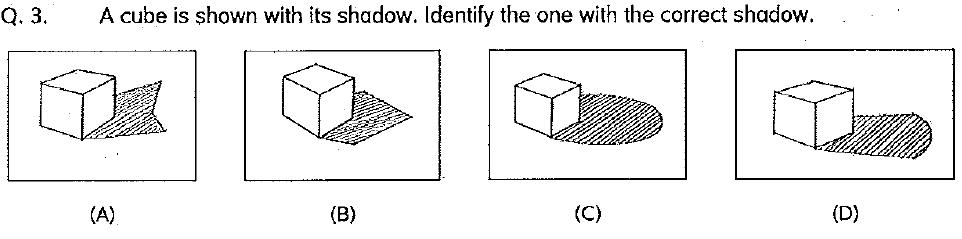
Question : 3
Identify shadow of the object
For this type of questions, you need to identify the direction of the sun/source; in this case its from left to right. For this cube you will count eight sharp edges. Trick is "higher the edge from ground and farther the edge from the sun/source, farther will be the shadow and only the top and side edges will have visible shadows".
Question : 4
Count the number of small cubes missing in this figure
The best thing is to count the missing cubes row-rise, starting from bottom; without being confused. Here I have given number of row-wise missing cubes from the bottom.
CEED exam generally tests candidate's design and communication ability. Here, we will discuss some general tips that are required for a designer as well as CEED aspirants. The following preliminary guidelines might help you make a preparation plan for CEED and helps you think like a "real designer". At the end of this page; list of preparations for PART-A and PART-B were separately given. This article is especially useful for the design thinking and design aptitude part of the CEED exam.
Note : You may watch the video tutorial at the end of this section if you don't want to read this entire article
Observation & Problem Identification
Before diving into the actual topic, let me clear you the importance of observation by the following exercise.
Below shows a picture of mine along with one of my colleague taken during my vacation. Please observe the picture carefully because i'm gonna ask you some questions from it.
Are you ready ?
Ok, without looking at the picture (cover the picture with your hands), answer the following questions
What is the color of the hat that i'm wearing ?
Did you see a water bottle ? What is the color of it ?
Where am I standing ?
How many girls/women, did you see in the picture ?
If you answer such type of questions, then I may consider you as a good observer, else you need to develop the same with proper practice, within time. Such is the importance of observation and every designer must be keen in observing everything - that they come across.
As said
earlier, CEED tests your knowledge in creativity and innovation. Now what does
it mean by creativity/innovation? It’s
your ability to develop an all new idea or modifying the existing idea based on
the requirements/demands of the user or of your own identification. Unless you
know about the existing idea, you cannot develop an alternative solution for
that. This is where your observation skills help you. You are required to be
keen about the surrounding things, products, mechanisms as well as people’s
interest. Start analyzing and you will find some interesting facts as well.
Trust me - this exercise will prove to be fun and help you improve your creative
thinking skills.
I will
clear this with an example. In your student life, you might have used hundreds
of pens, but did you ever thought (at least once) about the material of the
pen, its shape, diameter and so on. Did you ever compare any two pens ? Small things
appear silly, but actually they may help you. Keep an eye on your environment and
develop a hobby of more exposure.
Did you
notice; I combined observation and problem Identification under a single
heading. There are reasons for clubbing. When you start observing things, you
will come to know some problems as well as alternatives. In fact you
need to identify the problems. Problem identification is one most
important tool for a designer besides sketching. As discussed in my other posts,
every product will undergo frequent changes in design, usability and functionality.
Now do you think this happens because the companies get negative feedback from
the customers ?
It’s not like that. The companies look for problems
and developments by analyzing the users mind, trend and innovation. Even the CEED
examiners expect the same from you. So, be a problem generatoras well as solver. For example you take day-to-day things; say a
water bottle, identify or generate problems associated with it (keep in mind
the age category also), make a list and develop a new concept for this. You can
do this for simple objects.
"Be a problem generator"
Being Creative
Think
like a child. Children’s seems to be more creative than adults. Do you know why?
Because most of the time they raise the question why? That we don’t
do. Even during your child age, you might have done some interesting creations
(say art, drawings, prototypes and more). So, for every small thing - raise the
questions:
Why like this?
Why can’t be
like that?
In that way you can bring
back your creative skills.
Creativity may not be educated; one cannot force
you to create. It can be improved by your inner thoughts, personal passions and
exposure to creative ideas of others. Design - definitely should be a passion for
you, just for doing some degree or to choose some career path you cannot choose
design, that won’t seem to be successful because a good number of awesome
designers are out there competing with you.
You may improve your creativity and lateral thinking by growing the following links.
By now you
should be in a position to understand why I put the sketching topic as a third discussion instead of first. The very first focus of a designer is to develop the concept or Idea, next comes the way to
express/communicate that. Without a proper concept, you cannot start sketching.
For this reason only, the idea part of this session was discussed first (all
the above topics). Note that not all artists are designers, but almost all the
designers are good artists.
It’s not
like you can neglect sketching. Your design process is complete only when you
show case the same through proper channel (and its hand or digital sketching
for designers). Sketching is the process of showing your overall expression,
concept or idea. It even shows your talent. Drawing is a form of visual
communication (VC) and you may be aware that VC is the most powerful form of
delivering ideas.
So, a
CEED examiner usually expects you to be a good communicator and this is
confirmed by your sketching assignments in the exam. Drawing does carry more
marks. A simple narrow sketch with only pencil shades is recommended. You need
not use expert drawing techniques like oil painting and other coloring
techniques. This of course takes hell lot of time and you will be struck with a
single question without attempting others.
Time is a major factor during CEED
exam and you are required to draw all your sketching works in that constrained
time. The examiner simply expects your
ideas to be rightly communicated, and mostly not impressed by your coloring. Even
some persons who are excellent in pencil sketching are poor in coloring. Take
my case; I used to draw pencil drawings of Gods at the age of 14, the drawings looks
awesome, but whenever I apply colors to them, the drawings look dull.
There are
different views of drawing; of the all, perspective drawing is the most natural
one. You should be good at perspective drawing (with pencils and pens) and even
you should give importance to shading techniques. You must learn pencil shading
of objects on different surfaces (materials). Now please note that in your
question paper, lots of space will be given for rough work. Utilize this space
and show case your sketching process in a rough way. Remember that the examiner
is interested in your stages of design process and he might be going through it.
At this
point, I will give you a strategy of what I follow usually. Take a look
at the below picture; you will see roads and houses in a typical Indian street.
But to my
eyes, I visualize the scene as shown in the next picture. I started looking in a
perspective style. Wherever I go; whenever I travel by bike or car; whenever I
sit idle in a room or office; I look things, scenes and even individual objects
similarly as mentioned. This is definitely improving my visualization skills
and I hope this will even reduce time to learn and practice sketching. Give a
try and you will understand the difference within two or three days. You can
also make a habit of drawing whatever you see.
Customer oriented
Ultimately it’s the end-users who are going to enjoy your designed product. Be like a psychologist; understand user’s necessity, expectations, demands and trends. Necessity for different age groups will be different. So whenever you are doing some exercises as practice, be user-oriented. Think yourself as a user and list what you expect from that product and what you don’t want to be included in the product.
Video Gaming
Trust me, keeping your mind engaged with some mind and video games will help you develop alternative thought approach. Video gaming frees your boredom, and keeps your mind active. Gaming also helps you improve your problem solving skills. Alternative thinking is one most important quality of a good designer. Some preferred games are minesweeper, dots, sudoku and pewpew (in ios device).
"A person in bore mood cannot create ideas"
General Ability tests
There are some good tests that I recommend you to go through (as there is more time for preparation). Most of the times, this type of questions may not appear in CEED exams. But it does improve your creative thinking power and also helps you with patterns. These tests are fun and you can spend a little time for this part.
Social media became a hub for knowledge sharing. There are many designers, who regularly shares their creative works in creative social platforms. Social networking acts as a platform for this type of groups. Following and knowing them will help you expose to various design aspects, alternatives, concepts and also lets you identify your position and role as a design graduate.
The best social networking sites that I recommend to get in touch with creative people are listed below
You may also follow some designer blogs if you find more time.
Comic strips
It seems funny, but if you go through comic strips (like manga), you will come to know about how the author communicated the plot pictorially. Comic strips are really an amazing way of expressing your ideas in a funnier way. Japanese are famous for making manga. During leisure, you may go through some of the comic strips. You may even practice some stories in comic strip format.
Note :I suggest you to keep all your exercises (even though it is silly) with you. It may be helpful for your portfolio preparation.
Patterns
There is a separate subject for drawing in engineering first year called “Engineering Graphics”. I recommend CEED aspirants to go through them. The subject minds you to draw geometric objects in front, top, side as well as isometric views. By doing this drawing exercise, it’s likely that you will improve your thinking and visual perception skills. Also if you go through the previous CEED question papers, you will see pictorial questions similar to this and sometimes you are asked to draw three quarter views. For doing this quickly these exercises helps you.
I will now summarize the basic preparations for PART-A and PART-B sessions of CEED exam. Although there is no prescribed pattern for CEED examination, some of the below list may help you
PART-A
preparation check-list
Isometric drawings
General
Knowledge
Tessellations
Companies
and Brand logos
List of
famous Artists/designers and their works
List of
famous personalities in India
Knowledge
on color patterns
Focus on regular
“Fonts”
Abstract
Tests
PART-B
preparation check-list
Regular
observation
Problem generation
Creativity and Lateral thinking
Perspective
and Isometric drawings
Day-to-day
simple mechanisms
Sketching
and shading techniques
Developing habit of raising the question "why?"
CEED Preparation
Time
It
depends on personal capabilities. If you are a born-designer, then I may say
one month preparation is enough, for others a minimum of two months is required to
go through every process.
Here is a quick video tutorial on "Tips and steps for CEED exam Design-part preparation" :
You may also want to watch "How to start and what to practice for CEED exam ?"
Sharing is caring. Leave your suggestions, additions or views about this article in the comment section below. People will be happy to hear your views and might learn many things !